1,830 posters, 67 videos, 75 audios, 29 topics, 22 sessions, 4,727 authors, 1,697 institutions
ePostersLive by SciGen Technologies S.A. All rights reserved.
RCOG World Congress 2023
June 12 - 14, 2023 | London, UK

EP.0763
Takotsubo cardiomyopathy due to Ovarian torsion in a postmenopausal woman
Poster Presenter
Authors
Affiliations
Part of Topic
Benign Gynaecology
Takotsubo cardiomyopathy due to Ovarian torsion in a postmenopausal woman
Objective: To increase the awareness of transient acute cardiomyopathy associated with severe abdominal pain called Takotsubo cardiomyopathy (TC) characterized by acute left ventricular wall dysfunction. Patients present with acute chest pain and dyspnoea, with electrocardigraphic (ECG) abnormalities mimicking acute myocardial infarction and elevated cardiac troponin. We report a case of TC in a woman with severe abdominal pain due to ovarian torsion.
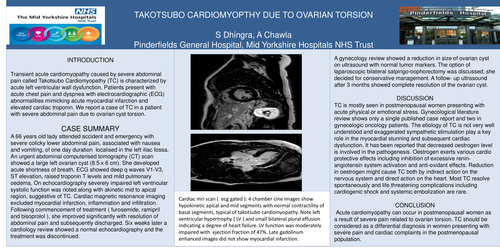
Case summary: A 66-year-old woman attended accident and emergency with severe colicky lower abdominal pain, associated with nausea and vomiting, of one day duration localized in the left iliac fossa. An urgent abdominal computerised tomography (CT) scan showed a large left ovarian cyst (8.5x6cm). She developed acute shortness of breath, and ECG showed deep q waves in V1 – V3, ST elevation, raised troponin T levels and mild pulmonary oedema. On echocardiography severely impaired left ventricular systolic function was noted along with akinetic mid to apical region, suggestive of TC. Cardiac magnetic resonance imaging excluded myocardial infarction, inflammation, and infiltration.
Following commencement of treatment (frusemide, ramipril and bisoprolol), she improved significantly with resolution of abdominal pain and was subsequently discharged. Six weeks later, a cardiology review showed normal echocardiography and the treatment was discontinued. A gynaecology review showed reduction in size of ovarian cyst, on ultrasound, with normal tumour markers. The option of laparoscopic bilateral salpingo-oophorectomy was discussed, she decided for conservative management. A follow-up ultrasound after 3 months showed complete resolution of the ovarian cyst.
Discussion: TC is mostly seen in postmenopausal women presenting with acute physical or emotional stress. Gynaecological literature review shows only a single published case report and 2 in gynaecologic oncology patients. The etiology of TC is not very well understood and exaggerated sympathetic stimulation play a key role in the myocardial stunning and subsequent cardiac dysfunction. It has been reported that decreased oestrogen level is involved in the pathogenic mechanism. Oestrogen exerts various cardioprotective effects including inhibition of excessive renin-angiotensin system activation and antioxidant effects. Reduction in oestrogen might cause TC both by indirect action on the nervous system and by direct action on the heart. Most TC resolves spontaneously and life-threatening complications including cardiogenic shock and systemic embolization are rare.
Conclusion: Acute cardiomyopathy can occur in postmenopausal women as a result of severe pain related to ovarian torsion. TC should be considered as a differential diagnosis in women presenting with severe pain and cardiac complaints in the postmenopausal population.