1,830 posters, 67 videos, 75 audios, 29 topics, 22 sessions, 4,727 authors, 1,697 institutions
ePostersLive by SciGen Technologies S.A. All rights reserved.
RCOG World Congress 2023
June 12 - 14, 2023 | London, UK

EP.0760
An Atypical Presentation of Amniotic Fluid Embolism
Poster Presenter
Authors
Affiliations
Part of Topic
High Risk Pregnancy
An Atypical Presentation of Amniotic Fluid Embolism: A case Report.
Nazish Zulfiqar ,Holly Venditti, Tatjana Nikisina – Department of Obstetrics and Gynaecology, Queen Alexandra Hospital, Portsmouth Hospitals University NHS Trust.
INTRODUCTION
The term amniotic fluid embolism (AFE) refers to a rare and serious obstetric emergency that can occur during pregnancy, labour, or delivery and can result in severe maternal and fetal morbidity and mortality. While the exact mechanisms of AFE are still not fully understood, it is thought to occur when amniotic fluid, fetal cells, hair, and other debris enter the maternal circulation, causing an inflammatory response that triggers a cascade of coagulation and inflammation, leading to cardiac arrest and respiratory failure.
In this case, we report a rare presentation of AFE, where the patient presented with isolated coagulopathy, without any other typical signs or symptoms of the condition. This unusual presentation underscores the need for clinicians to maintain a high degree of suspicion for AFE in any pregnant patient with unexplained coagulopathy, even in the absence of other clinical features. It also highlights the importance of considering alternative and atypical clinical presentations in complex and poorly understood medical conditions, such as AFE.
CASE PRESENTATION
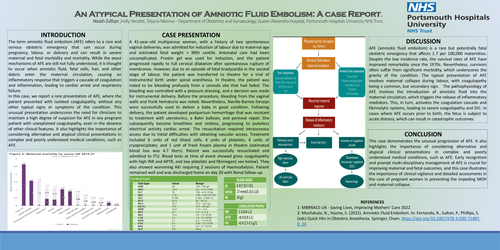
A 41-year-old multiparous woman, with a history of two spontaneous vaginal deliveries, was admitted for induction of labour due to maternal age and estimated fetal weight > 90th centile. Antenatal care had been uncomplicated. Prostin gel was used for induction, and the patient progressed rapidly to full cervical dilatation after spontaneous rupture of membranes. However, due to an episode of fetal bradycardia in the second stage of labour, the patient was transferred to theatre for a trial of instrumental birth under spinal anesthesia. In theatre, the patient was noted to be bleeding profusely from a cannula site that had failed. The bleeding was controlled with a pressure dressing, and a decision was made for instrumental delivery. Before the procedure, bleeding from the vaginal walls and frank hematuria was noted. Nevertheless, Neville-Barnes forceps were successfully used to deliver a baby in good condition. Following delivery, the patient developed postpartum hemorrhage that was resistant to treatment with uterotonics, a Bakri balloon, and perineal repair. She subsequently became breathless and restless, progressing to pulseless electrical activity cardiac arrest. The resuscitation required intraosseous access due to initial difficulties with obtaining vascular access. Treatment included 6 units of red blood cells, 4 units of platelets, 4 units of cryoprecipitate, and 1 unit of fresh frozen plasma in theatre (estimated blood loss was 4.7 liters). Patient was successfully resuscitated and admitted to ITU. Blood tests at time of event showed gross coagulopathy with high INR and APTR, and low platelets and fibrinogen( see below). They also showed worsening AKI requiring 2 sessions of Haemodialysis. Patient remained well and was discharged home on day 20 with Renal follow-up.
DISCUSSION
AFE (amniotic fluid embolism) is a rare but potentially fatal obstetric emergency that affects 1.7 per 100,000 maternities. Despite the low incidence rate, the survival rates of AFE have improved remarkably since the 1970s. Nevertheless, survivors often suffer from significant morbidity, which underscores the gravity of the condition. The typical presentation of AFE involves maternal collapse during labour, with coagulopathy being a common, but secondary sign. The pathophysiology of AFE involves the introduction of amniotic fluid into the maternal circulation, which triggers the release of inflammatory mediators. This, in turn, activates the coagulation cascade and fibrinolytic systems, leading to severe coagulopathy and DIC. In cases where AFE occurs prior to birth, the fetus is subject to acute distress, which can result in catastrophic outcomes.
CONCLUSION
This case demonstrates the unusual progression of AFE. It also highlights the importance of considering alternative and atypical clinical presentations in complex and poorly understood medical conditions, such as AFE. Early recognition and prompt multi-disciplinary management of AFE is crucial for improving maternal and fetal outcomes, and this case illustrates the importance of clinical vigilance and detailed assessments in the care of pregnant women in preventing the impeding MOH and maternal collapse.
REFERENCES
1: MBRRACE-UK - Saving Lives, Improving Mothers’ Care 2022
2: Muchatuta, N., Younie, S. (2022). Amniotic Fluid Embolism. In: Fernando, R., Sultan, P., Phillips, S. (eds) Quick Hits in Obstetric Anesthesia. Springer, Cham. https://doi.org/10.1007/978-3-030-72487-0_24