1,830 posters, 67 videos, 75 audios, 29 topics, 22 sessions, 4,727 authors, 1,697 institutions
ePostersLive by SciGen Technologies S.A. All rights reserved.
RCOG World Congress 2023
June 12 - 14, 2023 | London, UK

EP.0755
Spontaneous haematocolpos following an uncomplicated caesarean section
Poster Presenter
Authors
Affiliations
Part of Topic
Benign Gynaecology
Background
Acquired obstruction of the lower female genital tract leading to the development of haematocolpos, haematotrachelos and haematometra are rare. They are largely due to iatrogenic etiologies causing trauma to the uterine cervix such as cone biopsies, loop electrosurgical procedures, dilatation and curettage or radiation therapy [1-5]. In the context of a postnatal woman, it is most commonly from lacerations from normal vaginal deliveries that have resulted in vaginal/labial adhesions [6-7]. However, haematocolpos following a caesarean section, in the absence of any vaginal or cervical lacerations, has not yet been reported.
Case Presentation
Mdm A is a 33 year old lady with no known previous medical or surgical history, with a normal BMI of 20.1. Her first pregnancy was an uncomplicated pregnancy, which had resulted in an emergency caesarean section. She had went into spontaneous term labour, progressed to full dilatation but the foetus had remained in a persistent occipital posterior position at station 0 despite given adequate time for foetal head descent and pushing. She underwent an uncomplicated emergency caesarean section and was discharged well on post-operative day 3. The baby’s birth weight was 3378g. She attended her postnatal follow-up 4 weeks later with normal lochia, and a bedside ultrasound pelvis done was unremarkable. Mdm A presented 11 months after the caesarean section with a 2-month history of cyclical crampy lower abdominal pain. She had stopped breastfeeding 2 months prior, but had not started menstruating yet. She had attempted sexual intercourse on 3 occasions but was unable to achieve complete penetration. On examination, abdomen was soft non tender, vaginal examination noted a shortened vaginal tract with no cervix visualised.
Investigations
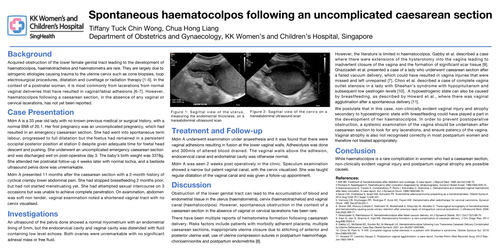
An ultrasound of the pelvis done showed a normal myometrium with an endometrial lining of 5mm, but the endocervical cavity and vaginal cavity was distended with fluid containing low level echoes. Both ovaries were unremarkable with no significant adnexal mass or free fluid.
Treatment and Follow-up
Mdm A underwent examination under anaesthesia and it was found that there were vaginal adhesions resulting in fusion at the lower vaginal walls. Adhesiolysis was done and 300mls of altered blood drained. The vaginal walls above the adhesion, endocervical canal and endometrial cavity was otherwise normal. Mdm A was seen 2 weeks post operatively in the clinic. Speculum examination showed a narrow but patent vaginal canal, with the cervix visualized. She was taught regular dilatation of the vaginal canal and was given a follow-up appointment.
Discussion
Obstruction of the lower genital tract can lead to the accumulation of blood and endometrial tissue in the uterus (haematometra), cervix (haematotrachelos) and vaginal canal (haematocolpos). However, spontaneous obstruction in the context of a caesarean section in the absence of vaginal or cervical lacerations has been rare. There have been multiple reports of hematometra formation following caesarean delivery. Risks factors include patients with morbidly adherent placenta, multiple caesarean sections, inappropriate uterine closure due to stitching of anterior and posterior uterine wall, use of uterine compression sutures in postpartum haemorrhage, chorioamnionitis and postpartum endometritis [8].
However, the literature is limited in haematocolpos. Gabby et al. described a case where there were extensions of the hysterotomy into the vagina leading to inadvertent closure of the vagina and the formation of significant scar tissue [9]. Ghazizadeh et al. presented a case of a lady who underwent caesarean section after a failed vacuum delivery, which could have resulted in vagina injuries that were missed and left unrepaired [7]. Choo et al. described a case of complete vagina outlet stenosis in a lady with Sheehan’s syndrome with hypopituitarism and subsequent low oestrogen levels [10]. A hypoestrogenic state can also be caused by breastfeeding, as described by Howard et al., where there was vaginal agglutination after a spontaneous delivery [11].
We postulate that in this case, non-clinically evident vaginal injury and atrophy secondary to hypoestrogenic state with breastfeeding could have played a part in the development of her haematocolpos. In order to prevent postoperative obstruction, a systemic examination of the vagina should be undertaken after caesarean section to look for any lacerations, and ensure patency of the vagina. Vaginal atrophy is also not recognised correctly in most postpartum women and therefore not treated appropriately.
Conclusion
While haematocolpos is a rare complication in women who had a caesarean section, non-clinically evident vaginal injury and postpartum vaginal atrophy are possible causes.