1,830 posters, 67 videos, 75 audios, 29 topics, 22 sessions, 4,727 authors, 1,697 institutions
ePostersLive by SciGen Technologies S.A. All rights reserved.
RCOG World Congress 2023
June 12 - 14, 2023 | London, UK

EP.0743
A Case of Intrauterine Death and Maternal Sepsis Associated with Rare Infection
Poster Presenter
Authors
Affiliations
Part of Topic
Pandemic and impact of Covid/Infectious Diseases
A Case of Intrauterine Death and Maternal Sepsis Associated with Rare Infection
OBJECTIVE
To present a case of severe sepsis due to an extremely rare organism, where a patient’s lifestyle and occupation can provide vital answers!
CASE STUDY
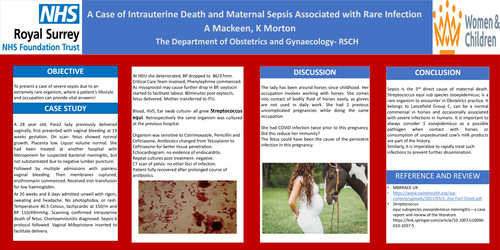
A 28 year old, Para2 lady previously delivered vaginally, first presented with vaginal bleeding at 19 weeks gestation. On scan- fetus showed normal growth. Placenta low. Liquor volume normal. She had been treated at another hospital with Meropenem for suspected bacterial meningitis, but not substantiated due to negative lumber puncture. Followed by multiple admissions with painless vaginal bleeding. Then membranes ruptured, erythromycin commenced. Received iron transfusion for low haemoglobin. At 20 weeks and 6 days admitted unwell with rigors, sweating and headache. No photophobia, or rash. Temperature 40.5 Celsius, tachycardic at 150/m and BP 110/49mmhg. Scanning confirmed intrauterine death of fetus. Chorioamnionitis diagnosed. Sepsis 6 protocol followed. Vaginal Mifepristone inserted to facilitate delivery. At HDU she deteriorated, BP dropped to 86/37mm. Critical Care Team involved; Phenylephrine commenced. As misoprostol may cause further drop in BP, oxytocin started to facilitate labour. 80minutes post oxytocin, fetus delivered. Mother transferred to ITU. Blood, HVS, Ear swab culture- all grew Streptococcus equi. Retrospectively the same organism was cultured at the previous hospital. Organism was sensitive to Cotrimoxazole, Penicillin and Ceftriaxone. Antibiotics changed from Teicoplanin to Ceftriaxone-for better tissue penetration. Echocardiogram: no evidence of endocarditis. Repeat cultures post treatment- negative. CT scan of pelvis: no other foci of infection. Patient fully recovered after prolonged course of antibiotics.
DISCUSSION
The lady has been around horses since childhood. Her occupation involves working with horses. She comes into contact of bodily fluid of horses easily, as gloves are not used in daily work. She had 2 previous uncomplicated pregnancies while doing the same occupation. She had COVID infection twice prior to this pregnancy. Did this reduce her immunity? The fetus could have been the cause of the persistent infection in this pregnancy.
CONCLUSION
Sepsis is the 3 rd direct cause of maternal death. Streptococcus equi sub species zooepidemicus; is a rare organism to encounter in Obstetrics practice. It belongs to Lancefield Group C, can be a normal commensal in horses and occasionally associated with severe infections in humans. It is important to always consider S zooepidemicus as a possible pathogen when contact with horses or consumption of unpasteurized cow’s milk products are part of the history. Similarly, it is imperative to rapidly treat such infections to prevent further dissemination.
REFERENCE AND REVIEW
• MBRRACE-UK
• https://www.swinehealth.org/wpcontent/uploads/2021/03/S.-Zoo-Fact-Sheet.pdf
• Streptococcus equi subspecies zooepidemicus meningitis—a case report and review of the literature https://link.springer.com/article/10.1007/s10096- 010-1037-5