1,830 posters, 67 videos, 75 audios, 29 topics, 22 sessions, 4,727 authors, 1,697 institutions
ePostersLive by SciGen Technologies S.A. All rights reserved.
RCOG World Congress 2023
June 12 - 14, 2023 | London, UK

EP.0742
Intrauterine Demise of Twin Pregnancy Secondary to SARS-CoV-2 Infection
Poster Presenter
Authors
Affiliations
Part of Topic
Pandemic and impact of Covid/Infectious Diseases
INTRODUCTION
SARS-CoV-2 infection is linked to adverse maternal and neonatal outcomes, with the highest risk seen in the third trimester of pregnancy. Furthermore, studies suggest that the likelihood of a poor outcome increases with the severity of the disease. Here we present a case of twin intrauterine demise at 31+3 weeks gestation in an asymptomatic patient, where the root cause was identified as placental insufficiency secondary to SARS-CoV-2 infection.
CASE SUMMARY
A 34 year old female, gravida 5, para 1+3, booked her pregnancy at 13+6 weeks gestation. Her past medical history included seropositive inflammatory arthritis with mild overlap of connective tissue disease, hypothyroidism, and a history of anaemia. Dating and anomaly scans confirmed monochorionic diamniotic (MCDA) twin pregnancy, with no fetal abnormalities. The patient had consultant-led antenatal care with specialist endocrine and fetal medicine input. She had regular fetal medicine scans which showed that both twins had normal growth velocity and there was no evidence of twin-to-twin transfusion syndrome, or intrauterine growth restriction. Unfortunately, at the 31+3 week scan, intrauterine demise (IUD) was confirmed for both twins. The patient was admitted for induction of labour in line with local guidelines. On admission, a SARS-CoV-2 test was done and confirmed asymptomatic maternal infection. Patient remained clinically well and asymptomatic throughout the intrapartum and postnatal period. Postmortem reports of both babies attributed the IUDs to placental insufficiency caused by massive perivillous fibrinous deposition (MPFD) secondary to maternal SARS-CoV-2 infection.
DISCUSSION
Prior to the pandemic, maternal infections such as those of the TORCH group, were known to result in placental and fetal transmission leading to adverse neonatal outcomes. As such, there was a growing concern at the beginning on the SARS-CoV-2 pandemic regarding the impact of infection on pregnancy outcomes. Histopathology findings of placentas affected with SARS-CoV-2 have helped understand how the virus affects placental physiology, thereby directly affecting fetal wellbeing.
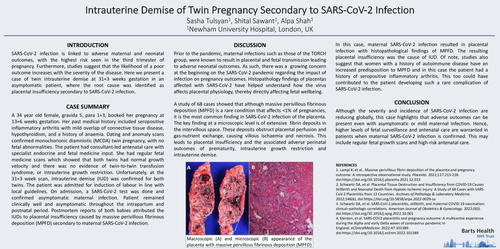
A study of 68 cases showed that although massive perivillous fibrinous deposition (MPFD) is a rare condition that affects <1% of pregnancies, it is the most common finding in SARS-CoV-2 infection of the placenta. The key finding at a microscopic level is of extensive fibrin deposits in the intervillous space. These deposits obstruct placental perfusion and gas-nutrient exchange, causing villous ischaemia and necrosis. This leads to placental insufficiency and the associated adverse perinatal outcomes of prematurity, intrauterine growth restriction and intrauterine demise.
In this case, maternal SARS-CoV-2 infection resulted in placental infection with histopathological findings of MPFD. The resulting placental insufficiency was the cause of IUD. Of note, studies also suggest that women with a history of autoimmune disease have an increased predisposition to MPFD and in this case the patient had a history of seropositive inflammatory arthritis. This too could have contributed to the patient developing such a rare complication of SARS-CoV-2 infection.
CONCLUSION
Although the severity and incidence of SARS-CoV-2 infection are reducing globally, this case highlights that adverse outcomes can be present even with asymptomatic or mild maternal infection. Hence, higher levels of fetal surveillance and antenatal care are warranted in patients when maternal SARS-CoV-2 infection is confirmed. This may include regular fetal growth scans and high-risk antenatal care.
REFERENCES
1. Lampi K, et al.. Massive perivillous fibrin deposition of the placenta and pregnancy outcome: A retrospective observational study. Placenta. 2022;117:213-218. doi:https://doi.org/10.1016/j.placenta.2021.12.013
2. Schwartz DA, et al. Placental Tissue Destruction and Insufficiency from COVID-19 Causes Stillbirth and Neonatal Death from Hypoxic-Ischemic Injury: A Study of 68 Cases with SARS-CoV-2 Placentitis from 12 Countries. Archives of Pathology & Laboratory Medicine. 2022;146(6). doi:https://doi.org/10.5858/arpa.2022-0029-sa
3. Schwartz DA, et al. SARS-CoV-2 placentitis, stillbirth, and maternal COVID-19 vaccination: clinical–pathologic correlations. American Journal of Obstetrics & Gynecology. 2022;0(0). doi:https://doi.org/10.1016/j.ajog.2022.10.001
4. Stenton, et al. SARS-COV2 placentitis and pregnancy outcome: A multicentre experience during the Alpha and early Delta waves of coronavirus pandemic in England. eClinicalMedicine. 2022;47:101389. doi:https://doi.org/10.1016/j.eclinm.2022.101389