1,830 posters, 67 videos, 75 audios, 29 topics, 22 sessions, 4,727 authors, 1,697 institutions
ePostersLive by SciGen Technologies S.A. All rights reserved.
RCOG World Congress 2023
June 12 - 14, 2023 | London, UK

EP.0073
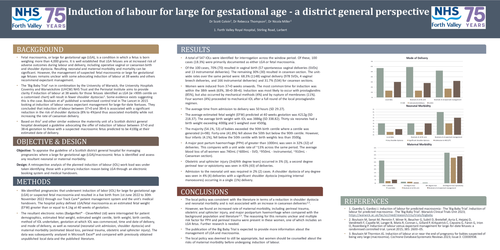
Induction of labour for large for gestational age a district general perspective
Poster Presenter
Authors
Affiliations
Part of Topic
Hot Topics (Emerging research/issues) in Obstetrics
Background
-
Fetal macrosomia, or large for gestational age (LGA), is a condition in which a fetus is born weighing more than 4,000 grams. It is well established that LGA fetuses are at increased risk of adverse outcomes during labour and delivery, including operative vaginal or caesarean birth and shoulder dystocia. Resulting neonatal and maternal morbidity and mortality can be significant. However, the management of suspected fetal macrosomia or large for gestational age fetuses remains unclear with some advocating induction of labour at 38 weeks and others recommend expectant management.
-
The ‘Big Baby Trial’ run in combination by the University of Warwick, the University HospitalsCoventry and Warwickshire (UHCW) NHS Trust and the Perinatal Institute aims to provide clarity if induction of labour at 38 weeks for those fetuses identified as LGA (ie >90th centile on a customised chart) will result in fewer shoulder dystocias1. Some evidence exists suggesting this is the case. Boulvain et al2 published a randomised control trial in The Lancet in 2015 looking at induction of labour versus expectant management for large-for-date foetuses. They concluded that induction of labour between 37+0 and 38+6 is associated with a significant reduction in the risk of shoulder dystocia (8% to 4%)and thus associated morbidity while not increasing the rate of caesarean delivery.
-
Based on this2 and other similar evidence the maternity unit of a Scottish district general hospital developed a guideline advocating the offer of induction of labour between 37+0 and 38+6 gestation to those with a suspected macrosomic fetus predicted to be 4100g at their estimated date of delivery.
OBJECTIVE & DESIGN
Objective: To appraise the guideline of a Scottish district general hospital for managing pregnancies where a large for gestational age (LGA)/macrosomic fetus is identified and assess any resultant neonatal or maternal morbidity.
Design: A retrospective analysis of the planned induction of labour (IOL) work load was under taken identifying those with a primary induction reason being LGA through an electronic booking system and medical handovers.
METHODS
-
We identified pregnancies that underwent induction of labor (IOL) for large for gestational age (LGA) or suspected fetal macrosomia and resulted in a live birth from 1st June 2022 to 30th November 2022 through our Track Care® patient management system and the unit's medical handovers. The hospital policy defined LGA/fetal macrosomia as an estimated fetal weight (EFW) greater than or equal to 4.1kg at 40 weeks of gestation.
-
The resultant electronic notes (BadgerNet® - CleverMed Ltd) were interrogated for patient demographics, estimated fetal weight, estimated weight centile, birth weight, birth centile, method of IOL undertaken, gestation at which IOL was commenced, time and date of delivery, and mode of delivery, as well as neonatal (neonatal unit admission, shoulder dystocia) and maternal morbidity (estimated blood loss, perineal trauma, obstetric anal sphincter injury). The data was subsequently analysed in Microsoft Excel® and compared with previously obtained unpublished local data and the published literature.
RESULTS
• A total of 547 IOLs were identified for interrogation across the window period. Of these, 100 cases (18.3%) were primarily documented as either LGA or fetal macrosomia.
• Of the 100 cases, 70% (70) resulted in vaginal birth (57 spontaneous vaginal deliveries (SVDs) and 13 instrumental deliveries). The remaining 30% (30) resulted in cesarean section. The unit- wide rates over the same period were: 68.3% (1148) vaginal delivery (978 SVDs, 4 vaginal breech deliveries, and 166 instrumental deliveries) and 31.7% (534) for cesarean sections.
• Women were induced from 37+0 weeks onwards. The most common time for induction was within the 38th week (63%, 38+0-38+6). Induction was most likely to occur with prostaglandins (85%), but also occurred by mechanical methods (4%) and by rupture of membranes (11%). Four women (4%) proceeded to mechanical IOL after a full round of the local prostaglandin regimen.
• The average time from admission to delivery was 50 hours (SD 29.27).
• The average estimated fetal weight (EFW) predicted at 40 weeks gestation was 4212g (SD 218.37). The average birth weight with IOL was 3886g (SD 338.82). Thirty-six neonates had a birth weight exceeding 4000g and 5 weighed over 4500g.
• The majority (54.1%, 53) of babies exceeded the 90th birth centile where a centile was generated (n=98). Forty-one (41.8%) fell above the 50th but below the 90th centile. However, four infants (4.1%), fell below the 50th centile with birth weights less than 3500g.
• A major post partum haemorrhage (PPH) of greater than 1000mL was seen in 32% (32) of deliveries. This compares with a unit wide rate of ~13% across the same period. The average blood loss of all women was 740mL (~600mL - SVD, ~950mL - Instrumental, ~910mL - Caesarean section).
• Obstetric anal sphincter injury (3rd/4th degree tears) occurred in 3% (3), a second degree perineal tear or episiotomy was seen in 43% (43) of deliveries.
• Admission to the neonatal unit was required in 2% (2) cases. A shoulder dystocia of any degree was seen in 4% (4) deliveries with a significant shoulder dystocia (requiring internal manoeuvres) occurring in a single (1%) delivery.
CONCLUSIONS
-
The local policy was consistent with the literature in terms of a reduction in shoulder dystocia and neonatal morbidity and is not associated with an increase in caesarean deliveries2,3.
-
However, we found an increased rate of maternal morbidity, including perineal trauma, obstetric anal sphincter injury, and major postpartum haemorrhage when compared with the background population and literature2,3. The reasoning for this remains unclear and multiple risk factor for PPH and perineal trauma were present in these women, one of which includes an LGA fetus. Further research is needed.
-
The publication of the Big Baby Trial is expected to provide more information about the management of LGA and macrosomia.
-
The local policy was deemed to still be appropriate, but women should be counselled about the risks of maternal morbidity before undergoing induction of labour.
References
• 1. Quenby S, Gardosi J. Induction of labour for predicted macrosomia - The 'Big Baby Trial‘. Induction of labour for predicted macrosomia - The 'Big Baby Trial‘. Warwick Clinical Trials Unit 2023;https://warwick.ac.uk/fac/sci/med/research/ctu/trials/bigbaby
• 2. Boulvain M, Senat M, Perrotin F, Winer N, Beucher G, Subtil D, BretelleF, Azria E, Hejaiej D, Vendittelli F, Capelle M, Langer B, Matis R, Connan L, Gillard P, Kirkpatrick C, Ceysens G, Faron G, Irion O, Rozenberg P. Induction of labour versus expectant management for large-for-date fetuses: a randomised controlled trial. Lancet 2015; 385: 2600–05.
• 3. Boulvain M Thornton JG. Induction of labour at or near the end of pregnancy for babies suspected of being very large (macrosomia). Cochrane Database Systematic Reviews 2023; Issue 3: CD000938.
-