1,830 posters, 67 videos, 75 audios, 29 topics, 22 sessions, 4,727 authors, 1,697 institutions
ePostersLive by SciGen Technologies S.A. All rights reserved.
RCOG World Congress 2023
June 12 - 14, 2023 | London, UK

EP.0733
PHEOCHROMOCYTOMA IN PREGNANCY: A CASE REPORT
Poster Presenter
Part of Topic
High Risk Pregnancy
PHEOCHROMOCYTOMA IN PREGNANCY: A CASE REPORT
Objective: To describe a case of a 30-year-old pregnant woman with a chief complaint of palpitations and headache as presentation of a rare catecholamine-secreting tumor which is only seen 0.007% of all pregnancies and can be fatal to both mother and fetus.
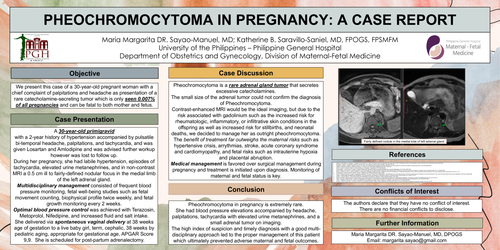
Case presentation: A 30-year-old primigravid with a 2-year history of hypertension accompanied by pulsatile bi-temporal headache, palpitations, and tachycardia, and was given Losartan and Amlodipine and was advised further workup however was lost to follow up. During her pregnancy, she had labile hypertension, episodes of tachycardia, elevated urine metanephrines, and in non-contrast MRI a 0.5 cm ill to fairly-defined nodular focus in the medial limb of the left adrenal gland. Multidisciplinary management consisted of frequent blood pressure monitoring, fetal well-being studies such as fetal movement counting, biophysical profile twice weekly, and fetal growth monitoring every 2 weeks. Optimal blood pressure control was achieved with Terazosin, Metoprolol, Nifedipine, and increased fluid and salt intake. She delivered via spontaneous vaginal delivery at 38 weeks age of gestation to a live baby girl, term, cephalic, 38 weeks by pediatric aging, appropriate for gestational age, APGAR Score 9,9. She is scheduled for post-partum adrenalectomy.
Case discussion: Pheochromocytoma is a rare adrenal gland tumor that secretes excessive catecholamines. The small size of the adrenal tumor could not confirm the diagnosis of Pheochromocytoma. Contrast-enhanced MRI would be the ideal imaging, but due to the risk associated with gadolinium such as the increased risk for rheumatologic, inflammatory, or infiltrative skin conditions in the offspring as well as increased risk for stillbirths, and neonatal deaths, we decided to manage her as outright pheochromocytoma. The benefit of treatment far outweighs the maternal risks such as hypertensive crisis, arrythmias, stroke, acute coronary syndrome and cardiomyopathy, and fetal risks such as intrauterine hypoxia and placental abruption. Medical management is favored over surgical management during pregnancy and treatment is initiated upon diagnosis. Monitoring of maternal and fetal status is key.
Conclusions: Pheochromocytoma in pregnancy is extremely rare. She had blood pressure elevations accompanied by headache, palpitations, tachycardia with elevated urine metanephrines, and a small adrenal tumor on imaging. The high index of suspicion and timely diagnosis with a good multi-disciplinary approach led to the proper management of this patient which ultimately prevented adverse maternal and fetal outcomes.
Keywords: Hypertension, Pregnancy, Pheochromocytoma, catecholamine excess