1,830 posters, 67 videos, 75 audios, 29 topics, 22 sessions, 4,727 authors, 1,697 institutions
ePostersLive by SciGen Technologies S.A. All rights reserved.
RCOG World Congress 2023
June 12 - 14, 2023 | London, UK

EP.0732
ISOLATED FALLOPIAN TUBE TORSION: A RARE CAUSE OF ACUTE ABDOMEN
Poster Presenter
Authors
Ankita Pandey, Joseph Mechery, Nosheen Akhtar, Olubukola Ogunbiyi
Affiliations
Part of Topic
Benign Gynaecology
Background: Isolated torsion of the fallopian tube (IFTT) is an extremely rare finding in a female patient presenting with acute lower abdominal pain. It has no classical clinical features and there are no reliable radiological investigations that would prompt the clinician to suspect this rare condition. Diagnosis is therefore often delayed until laparoscopy after which time it is often too late to salvage the tube from irreversible ischaemic damage.
Methods Used: A 39 years old nulliparous woman with subfertility presented to A&E department with a 2-day history of acute, constant left lower abdominal pain. She denied any urinary, bowel symptoms, fevers or any vaginal discharge. She had a prior admission two months back with similar complains, and pelvic ultrasound was suggestive of left sided hydrosalpinx. She was treated as per PID protocol and was discharged later after her symptoms resolved. Since, she was trying to conceive for last 18 months, was seen in fertility clinic and planned for salpingectomy prior to IVF.
Investigations: On admission, she was afebrile, tender in the left iliac fossa with guarding. Inflammatory markers were normal.
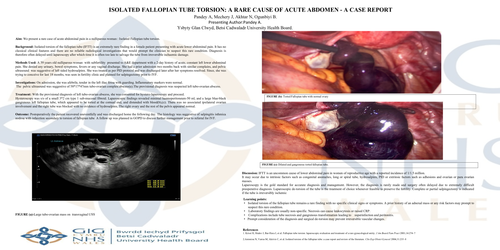
The pelvic ultrasound was suggestive of 58*17*47mm tubo-ovarian complex/abscess(a).The provisional diagnosis was suspected left tubo-ovarian abscess.
Treatment: With the provisional diagnosis of left tubo-ovarian abscess, she was consented for hystero-laparoscopy and proceed.
Hysteroscopy was s/o of a small 3*2 cm type 1 sub-mucosal fibroid. Laparoscopic findings revealed minimal haemoperitoneum-50 ml, and a large blue-black gangrenous left fallopian tube, which appeared to be torted at the cornual end, and distended with blood(b),(c). There was no associated ipsilateral ovarian involvement and the right tube was blocked with no evidence of hydrosalpinx. The right ovary and the rest of the pelvis appeared normal.
Outcome: Postoperatively the patient recovered uneventfully and was discharged home the following day. The histology was suggestive of salpingitis isthmica nodosa with infarction secondary to torsion of fallopian tube A follow up was planned in GOPD to discuss further management prior to referral for IVF
Discussion: IFTT is an uncommon cause of lower abdominal pain in women of reproductive age with a reported incidence of 1/1.5 million.
It may occur due to intrinsic factors such as congenital anomalies, long or spiral tube, hydrosalpinx, PID or extrinsic factors such as adhesions and ovarian or para ovarian masses.
Laparoscopy is the gold standard for accurate diagnosis and management. However, the diagnosis is rarely made and surgery often delayed due to extremely difficult preoperative diagnosis. Laparoscopic de-torsion of the tube is the treatment of choice whenever feasible to preserve the fertility. Complete or partial salpingectomy is indicated if the tube is irreversibly ischemic