1,830 posters, 67 videos, 75 audios, 29 topics, 22 sessions, 4,727 authors, 1,697 institutions
ePostersLive by SciGen Technologies S.A. All rights reserved.
RCOG World Congress 2023
June 12 - 14, 2023 | London, UK

EP.0725
Pyometra in a postmenopausal woman caused by Cytomegalovirus infection: A case report.
Poster Presenter
Part of Topic
Benign Gynaecology
Pyometra in a postmenopausal woman caused by Cytomegalovirus infection: A case report.
Objective
To highlight Cytomegalovirus infection as a rare cause for pyometra in postmenopausal women.
Case Report
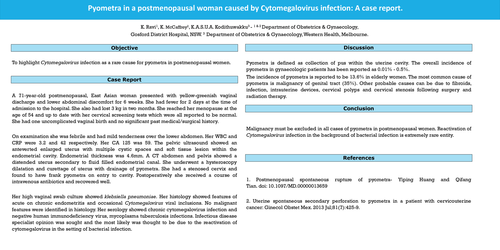
A 71-year-old postmenopausal, East Asian woman presented with yellow-greenish vaginal discharge and lower abdominal discomfort for 6 weeks. She had fever for 2 days at the time of admission to the hospital. She also had lost 3 kg in two months. She reached her menopause at the age of 54 and up to date with her cervical screening tests which were all reported to be normal. She had one uncomplicated vaginal birth and no significant past medical/surgical history. On examination she was febrile and had mild tenderness over the lower abdomen. Her WBC and CRP were 3.2 and 42 respectively. Her CA 125 was 59. The pelvic ultrasound showed an anteverted enlarged uterus with multiple cystic spaces and soft tissue lesion within the endometrial cavity. Endometrial thickness was 4.6mm. A CT abdomen and pelvis showed a distended uterus secondary to fluid filled endometrial canal. She underwent a hysteroscopy dilatation and curettage of uterus with drainage of pyometra. She had a stenosed cervix and found to have frank pyometra on entry to cavity. Postoperatively she received a course of intravenous antibiotics and recovered well. Her high vaginal swab culture showed klebsiella pneumoniae. Her histology showed features of acute on chronic endometritis and occasional Cytomegalovirus viral inclusions. No malignant features were identified in histology. Her serology showed chronic cytomegalovirus infection and negative human immunodeficiency virus, mycoplasma tuberculosis infections. Infectious disease specialist opinion was sought and the most likely was thought to be due to the reactivation of cytomegalovirus in the setting of bacterial infection.
Discussion
Pyometra is defined as collection of pus within the uterine cavity. The overall incidence of pyometra in gynaecologic patients has been reported as 0.01% - 0.5%. The incidence of pyometra is reported to be 13.6% in elderly women. The most common cause of pyometra is malignancy of genital tract (35%). Other probable causes can be due to fibroids, infection, intrauterine devices, cervical polyps and cervical stenosis following surgery and radiation therapy.
Conclusion
Malignancy must be excluded in all cases of pyometra in postmenopausal women. Reactivation of Cytomegalovirus infection in the background of bacterial infection is extremely rare entity.
References
- Postmenopausal spontaneous rupture of pyometra- Yiping Huang and Qifang Tian. doi: 10.1097/MD.0000000000013659
- Uterine spontaneous secondary perforation to pyometra in a patient with cervicouterine cancer: Ginecol Obstet Mex. 2013 Jul;81(7):425-9.