1,830 posters, 67 videos, 75 audios, 29 topics, 22 sessions, 4,727 authors, 1,697 institutions
ePostersLive by SciGen Technologies S.A. All rights reserved.
RCOG World Congress 2023
June 12 - 14, 2023 | London, UK

EP.0723
Regional Anaesthesia – the potential new norm for gynaecological surgery?
Poster Presenter
Part of Topic
Hot Topics (Emerging research/issues) in Gynaecology
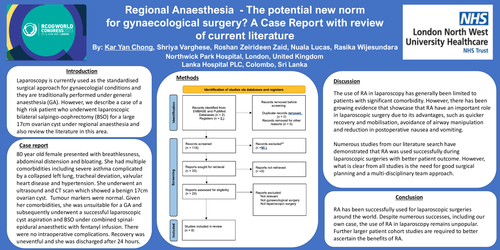
Regional Anaesthesia - The potential new norm for gynaecological surgery? A Case Report with review of current literature
Introduction
Laparoscopy is currently used as the standardised surgical approach for gynaecologial conditions and they are traditionally performed under general anaesthesia (GA). However, we describe a case of a high risk patient who underwent laparoscopic bilateral salpingo-oophrectomy (BSO) for a large 17cm ovarian cyst under regional anaesthesia and also review the literature in this area.
Case report
80 year old female presented with breathlessness, abdominal distension and bloating. She had multiple comorbidities including severe asthma complicated by a collapsed left lung, tracheal deviation, valvular heart disease and hypertension. She underwent an ultrasound and CT scan which showed a benign 17cm ovarian cyst. Tumour markers were normal. Given her comorbidities, she was unsuitable for a GA and subsequently underwent a successful laparoscopic cyst aspiration and BSO under combined spinal-epidural anaesthetic with fentanyl infusion. There were no intraoperative complications. Recovery was uneventful and she was discharged after 24 hours.
Methods
We performed a literature search using EMBASE and PubMed using terms 'Gynaecology', 'Regional anaesthesia' and 'Laparascopy'. This resulted in 115 articles. After screening for relevance, only 8 articles were included.
Discussion
The use of RA in laparoscopy has generally been limited to patients with significant comorbidity. However, there has been growing evidence that showcase that RA have an important role in laparoscopic surgery due to its advantages, such as quicker recovery and mobilisation, avoidance of airway manipulation and reduction in postoperative nausea and vomiting.
Numerous studies from our literature search have demonstrated that RA was used successfully during laparoscopic surgeries with better patient outcome. However, what is clear from all studies is the need for good surgical planning and a multi-disciplinary team approach.
Conclusion
RA has been successfully used for laparoscopic surgeries around the world. Despite numerous successes, including our own case, the use of RA in laparoscopy remains unpopular. Further larger patient cohort studies are required to better ascertain the benefits of RA.