1,830 posters, 67 videos, 75 audios, 29 topics, 22 sessions, 4,727 authors, 1,697 institutions
ePostersLive by SciGen Technologies S.A. All rights reserved.
RCOG World Congress 2023
June 12 - 14, 2023 | London, UK

EP.0722
A case study: Refractory immune thrombocytopaenia and use of eltrombopag in pregnancy
Poster Presenter
Part of Topic
Maternal Medicine
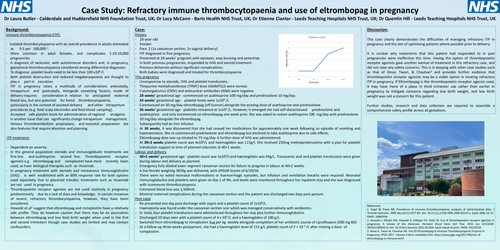
Case Study: Refractory immune thrombocytopaenia and use of eltrombopag in pregnancy
Dr Laura Butler - Calderdale and Huddersfield NHS Foundation Trust, UK; Dr Lucy McCann - Barts Health NHS Trust, UK; Dr Etienne Ciantar - Leeds Teaching Hospitals NHS Trust, UK; Dr Quentin Hill - Leeds Teaching Hospitals NHS Trust, UK
Background:
Immune thrombocytopaenia (ITP):
- Isolated thrombocytopaenia with an overall prevalence in adults estimated as 9.5 per 100,000 1.
- To diagnose: platelet levels need to be less than 100 x109 /l.
- Both platelet destruction and reduced megakaryopoiesis are thought to play a part in causation.
- ITP in pregnancy raises a multitude of considerations antenatally, intrapartum and postnatally. Alongside coexisting factors, mode of delivery requires consideration in relation to anticipated maternal blood loss, but also potential for foetal thrombocytopaenia, particularly in the context of assisted delivery and other intrapartum procedures (e.g. fetal scalp electrodes and fetal blood sampling). Accepted safe platelet levels for administration of regional analgesia Is another issue that can significantly change intrapartum management. Venous thromboembolism prophylaxis, and neonatal preparation are also features that require attention and planning.
ITP treatment:
- Dependent on severity.
- In the general population steroids and immunoglobulin treatments are first line and azathioprine second line. Thrombopoietin receptor agonists e.g. eltrombopag and romiplostim have more recently been used, as have biological therapies such as rituximab.
- In pregnancy treatment with steroids and intravenous immunoglobulins (IVIG) is well established with an 80% response rate for both options used separately. Due to placental transfer, treatments such as rituximab are not used in pregnancy.
Case:
History
This pregnancy
- 34 weeks’ gestational age - platelet levels were 1x10⁹ /L
- 36 weeks’ gestational age - platelets remained at 1x10⁹ /L. However, it emerged she had self-discontinued prednisolone and azathioprine and only commenced on eltrombopag one week prior. She was asked to restart azathioprine 100 mg/day with prednisolone 10 mg/day alongside the eltrombopag.
Labour and delivery
- Estimated blood loss was 1,500mls.
Post natal
Discussion:
This case clearly demonstrates the difficulties of managing refractory ITP in pregnancy and the aim of optimising patients where possible prior to delivery.
It is unclear why treatments that this patient had responded to in past pregnancies were ineffective this time. Having the option of thrombopoietin receptor agonists gave another avenue of treatment in this refractory case, and did not raise any safety concerns. This is in keeping with other case studies such as that of Desai, Tiwari, & Chauhan3 and provides further evidence that thrombopoietin receptor agonists may be a viable option in treating refractory ITP in pregnancy. If Eltrombopag is the thrombopoietin receptor agonist used, it may have more of a place in third trimester use rather than earlier in pregnancy to mitigate concerns regarding low birth weight, and low birth weight was not a concern for this patient.
Further studies, research and data collection are required to assemble a comprehensive safety profile across all gestations.
References
1. Segal JB, Powe NR. Prevalence of immune thrombocytopenia: analyses of administrative data. J Thromb Haemost. 2006 Nov;4(11):2377-83. doi: 10.1111/j.1538-7836.2006.02147.x. Epub 2006 Jul 27. PMID: 16869934
2. Howaidi J, AlRajhi AM, Howaidi A, AlNajjar FH, Tailor IK. Use of thrombopoietin receptor agonists in pregnancy: A review of the literature. Hematol Oncol Stem Cell Ther. 2021 Jun 16:S1658-3876(21)00055-8. doi: 10.1016/j.hemonc.2021.05.004. Epub ahead of print. PMID: 34153229.
3. Desai A, Tiwari N, Chauhan AR. Use Of Eltrombopag In Immune Thrombocytopenic Purpura In Pregnancy. JPGO 2017. Volume 4 No.6. Available from: http://www.jpgo.org/2017/06/use-of-eltrombopag-in-immune.html