1,830 posters, 67 videos, 75 audios, 29 topics, 22 sessions, 4,727 authors, 1,697 institutions
ePostersLive by SciGen Technologies S.A. All rights reserved.
RCOG World Congress 2023
June 12 - 14, 2023 | London, UK

EP.0717
Progression of Cervical Cancer in a Twin Pregnancy
Poster Presenter
Authors
Andrew Taylor, Giovana Charite, Saida Bowe, Shamanique Bodie-Williams
Affiliations
Part of Topic
Gynae Oncology
Progression of Cervical Cancer in Twin Pregnancy
Dr. A. Taylor BSc. MBBS, Dr. Giovana Charite BSc. MBBS, Dr. S. Bowe BSc, MBBS, DM, Dr. S. Bodie-Williams BSc, MD, MSc, DMAS
The Rand Memorial Hospital, Grand Bahama Health Services
Introduction
Cervical cancer is primarily caused by persistent Human Papilloma Virus (HPV) infections. HPV is a DNA virus, has over 100 documented genotypes 40 of which are known to infect the anogenital tract. Between 12 and 14 are “high risk” genotypes, those that can cause progression to cancer. Compared with other gynecologic malignancies, cervical cancer develops in a younger population with a median age of 52 and average age of 45.
Cancer during pregnancy is defined as a tumor diagnosed in pregnant women or in the immediate postpartum. Incidence slowly increasing largely in part to delayed child bearing. Cervical Cancer is the second most common neoplasia diagnosed during pregnancy. It occurs in ~ 0.004 - 0.1% of pregnancies. Due to the rarity a management conundrum arises.
Aims of Management
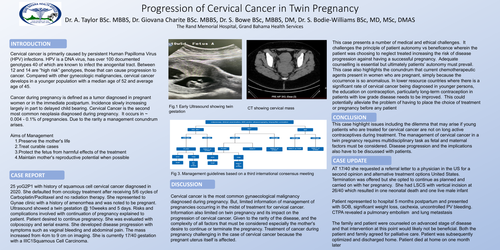
25 yoG2P1 with history of squamous cell cervical cancer diagnosed in 2020. She defaulted from oncology treatment after receiving 5/6 cycles of Carboplatin/Paclitaxel and no radiation therapy. She represented to Gynae clinic with a history of amenorrhea and was noted to be pregnant. Ultrasound showed a twin gestation @ 10weeks and 5 days. Risks and complications involved with continuation of pregnancy explained to patient. Patient desired to continue pregnancy. She was evaluated with colposcopy and serial exams. She developed disease progression with symptoms such as vaginal bleeding and abdominal pain. The mass increased from 4cm to 9 cm on imaging. She is currently 17/40 gestation with a IIIC1Squamous Cell Carcinoma.
Discussion
Cervical cancer is the most common gynaecological malignancy diagnosed during pregnancy. But, limited information of management of pregnancies occurring in the midst of treatment for cervical cancer. Information also limited on twin pregnancy and its impact on the progression of cervical cancer. Given to the rarity of the disease, and the complexity of all factors that must be considered especially the mother's desire to continue or terminate the pregnancy. Treatment of cancer during pregnancy challenging in the case of cervical cancer because the pregnant uterus itself is affected.
This case presents a number of medical and ethical challenges. It challenges the principle of patient autonomy vs beneficence wherein the patient was choosing to neglect treated increasing the risk of disease progression against having a successful pregnancy. Adequate counselling is essential but ultimately patients’ autonomy must prevail. This case also highlights the conundrum that current chemotherapeutic agents present in women who are pregnant, simply because the occurrence is so anomalous. In lower resource countries where there is a significant rate of cervical cancer being diagnosed in younger persons, the education on contraception, particularly long-term contraception in patients with low grade disease needs to be improved. This could potentially alleviate the problem of having to place the choice of treatment or pregnancy before any patient
Conclusion
This case highlight issues including the dilemma that may arise if young patients who are treated for cervical cancer are not on long active contraceptives during treatment. The management of cervical cancer in a twin pregnancy requires multidisciplinary task as fetal and maternal factors must be considered. Disease progression and the implications also have to be discussed with patients.
Case Update
AT 17/40 she requested a referral letter to a physician in the US for a second opinion and alternative treatment options United States. Termination was offered but she opted to continue as planned and carried on with her pregnancy. She had LSCS with vertical incision at 26/40 which resulted in one neonatal death and one live male infant
Patient represented to hospital 5 months postpartum and presented with SOB, significant weight loss, cachexia, uncontrolled PV bleeding. CTPA revealed a pulmonary embolism and lung metastasis. The family and patient were counseled on advanced stage of disease and that intervention at this point would likely not be beneficial. Both the patient and family agreed for palliative care. Patient was subsequently optimized and discharged home. Patient died at home on one month later