1,830 posters, 67 videos, 75 audios, 29 topics, 22 sessions, 4,727 authors, 1,697 institutions
ePostersLive by SciGen Technologies S.A. All rights reserved.
RCOG World Congress 2023
June 12 - 14, 2023 | London, UK

EP.0712
RARE CASE OF PLACENTA ACCRETA IN LEFT HORN OF 19 WEEK UTERUS
Poster Presenter
Authors
Affiliations
Part of Topic
High Risk Pregnancy
Video
Audio
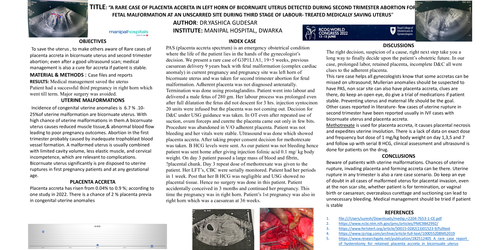
TITLE: “A RARE CASE OF PLACENTA ACCRETA IN LEFT HORN OF BICORNUATE UTERUS DETECTED DURING SECOND TRIMESTER ABORTION FOR FETAL MALFORMATION AT AN UNSCARRED SITE DURING THIRD STAGE OF LABOUR- TREATED MEDICALLY SAVING UTERUS”
AUTHOR: DR.YASHICA GUDESAR
INSTITUTE: MANIPAL HOSPITAL, DWARKA
OBJECTIVES
To save the uterus , to make others aware of Rare cases of placenta accreta in bicornuate uterus and second trimester abortion; even after a good ultrasound scan; medical management is also a cure for accreta if patient is stable.
MATERIAL & METHODS : Case files and reports
RESULTS: Medical management saved the uterus
Patient had a successful third pregnancy in right horn which went till term. Major surgery was avoided.
UTERINE MALFORMATIONS
Incidence of congenital uterine anomalies is 6.7 % .10-25%of uterine malformation are bicornuate uterus. With high chance of uterine malformations in them.A bicornuate uterus causes reduced muscle tissue,& abnormal blood flow leading to poor pregnancy outcomes. Abortion in the first trimester probably caused by inadequate trophoblast blood vessel formation. A malformed uterus is usually combined with limited cavity volume, less elastic muscle, and cervical incompetence, which are relevant to complications.
Bicornuate uterus significantly is pre disposed to uterine ruptures in first pregnancy patients and at any gestational age.
PLACENTA ACCRETA
Placenta accreta has risen from 0.04% to 0.9 %; according to one study in 2022. There is a chance of 2 % placenta previa in congenital uterine anomalies
INDEX CASE
PAS (placenta accreta spectrum) is an emergency obstetrical condition where the life of the patient lies in the hands of the gynecologist’s decision. We present a rare case of G3P1L1A1, 19+5 weeks, previous caesarean delivery 9 years back with fetal malformation (complex cardiac anomaly) in current pregnancy and pregnancy site was left horn of bicornuate uterus and was taken for second trimester abortion for fetal malformation. Adherent placenta was not diagnosed antenatally. Termination was done using prostaglandins. Patient went into labour and delivered a male fetus of 280 gm. Her labour process was prolonged even after full dilatation the fetus did not descent for 3 hrs. injection syntocinon 20 units were infused but the placenta was not coming out. Decision for D&C under USG guidance was taken. In OT even after repeated use of suction, ovum forceps and curette the placenta came out only in few bits. Procedure was abandoned in V/O adherent placenta. Patient was not bleeding and her vitals were stable. Ultrasound was done which showed placenta accreta. After taking proper consent decision for methotrexate was taken. B HCG levels were sent. As our patient was not bleeding hence patient was sent home after giving injection folinic acid 0.1 mg/ kg body weight. On day 3 patient passed a large mass of blood and fibrin, ?placental chunk. Day 3 repeat dose of methotrexate was given to the patient. Her LFT’s, CBC were serially monitored. Patient had her periods in 1 week. Post that her B HCG was negligible and USG showed no placental tissue. Hence no surgery was done in this patient. Patient accidentally conceived in 3 months and continued her pregnancy. This time the pregnancy was in right horn. Patient’s 1st pregnancy was also in right horn which was a caesarean at 36 weeks.
DISCUSSIONS
The right decision, suspicion of a cause, right next step take you a long way to finally decide upon the patient’s obstetric future. In our case, prolonged labor, retained placenta, incomplete D&C all were clues to the adherent placenta.
This rare case helps all gynecologists know that some accretas can be missed on ultrasound; Mullerian anomalies should be suspected to have PAS, non scar site can also have placenta accreta, clues are there, do keep an open eye, do give a trial of medications if patient stable. Preventing uterus and maternal life should be the goal.
Other cases reported in literature- few cases of uterine rupture in second trimester have been reported usually in IVF cases with bicornuate uterus and placenta accreta.
Methotrexate is used for placenta accreta, it causes placental necrosis and expedites uterine involution. There is a lack of data on exact dose and frequency but dose of 1 mg/kg body weight on day 1,3,5 and 7 and follow up with serial B HCG, clinical assessment and ultrasound is done for patients on the drug.
CONCLUSIONS
Beware of patients with uterine malformations. Chances of uterine rupture, invading placenta and forming accreta can be there. Uterine rupture in any trimester is also a rare case scenario. Do keep an eye of doubt in all cases of malformed uterus for placental invasion, even at the non scar site, whether patient is for termination, or vaginal birth or caesarean; overzealous curettage and suctioning can lead to unnecessary bleeding. Medical management should be tried if patient is stable
REFERENCES