1,830 posters, 67 videos, 75 audios, 29 topics, 22 sessions, 4,727 authors, 1,697 institutions
ePostersLive by SciGen Technologies S.A. All rights reserved.
RCOG World Congress 2023
June 12 - 14, 2023 | London, UK

EP.0711
Expectant management of placenta previa accreta
Poster Presenter
Authors
Affiliations
Part of Topic
High Risk Pregnancy
abstract:
·The incidence of placenta accreta spectrum (PAS) disorders have risen over the last decades, and there has been a gradual shift towards expectant management.
· Conservative management of PAS is known to reduce major obstetric hemorrhage and salvage hysterectomy. There is a lack of consensus on the follow-up of patients undergoing conservative approaches.
·Here, we describe the follow-up of one patient with placenta accreta who is conservatively managed by keeping placenta insitu and review the literature for the conservative management of PAS.
·Although elective caesarean hysterectomy is the standard practice, the choice of conservative management has emerged into practice
Case presentation:
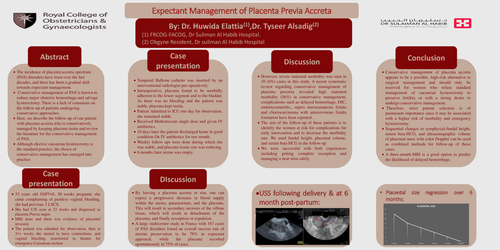
·33 years old G6P5+0, 30 weeks pregnant, she came complaining of painless vaginal bleeding, she had previous 3 LSCS.
·She had U/S scan at 23 weeks and diagnosed as placenta Previa major.
·MRI done and there was evidence of placental invasion
·The patient was admitted for observation, then at 31+ weeks she started to have contractions, and vaginal bleeding, transferred to theatre for emergency Caesarean section
·Temporal Balloon catheter was inserted by an interventional radiologist pre-operatively.
·Intraoperative, placenta found to be morbidly adherent to the lower segment and to the bladder. As there was no bleeding and the patient was stable, placenta kept insitu.
·Patient Admitted to ICU one day for observation, she remained stable.
·Received Methotrexate single dose and given IV antibiotics.
·10 days later the patient discharged home in good condition On IV antibiotics for one month.
·Weekly follow ups were done during which she was stable, and placenta tissue size was reducing.
·6 months later uterus was empty.
Discussion:
·By leaving a placenta accreta in situ, one can expect a progressive decrease in blood supply within the uterus, parametrium, and the placenta. This will result in secondary necrosis of the villous tissue, which will result in detachment of the placenta, and finally resorption or expulsion.
·A large multicenter study in France with 167 cases of PAS disorders found an overall success rate of uterine preservation to be 78% in expectant approach, while the placenta resorbed spontaneously in 75% of cases.
·However, severe maternal morbidity was seen in 10 (6%) cases in this study. A recent systematic review regarding conservative management of placenta percreta revealed high maternal morbidity (56%) in conservative management, complications such as delayed hemorrhage, DIC, endomyometritis,, sepsis uterocutaneous fistula and choriocarcinoma with arteriovenous fistula formation have been reported .
·The aim of the follow-up of these patients is to identify the women at risk for complications for early intervention and to decrease the morbidity rate. We used fundal height, placental volume, and serum beta-HCG in the follow-up
·We were successful with both experiences including getting complete resorption and managing a near miss safely
Conclusion:
·Conservative management of placenta accreta appears to be a possible, high-risk alternative to surgical management and should only be reserved for women who refuse standard management of caesarean hysterectomy to preserve fertility or with a strong desire to undergo conservative management.
· Therefore, strict patient selection is of paramount importance since it may be associated with a higher risk of morbidity and emergency hysterectomy.
·Sequential changes in symphysial-fundal height, serum beta-HCG, and ultrasonographic volume of placental mass with color Doppler can be used as combined methods for follow-up of these cases.
·A three-month-MRI is a good option to predict the likelihood of delayed hemorrhage.