1,830 posters, 67 videos, 75 audios, 29 topics, 22 sessions, 4,727 authors, 1,697 institutions
ePostersLive by SciGen Technologies S.A. All rights reserved.
RCOG World Congress 2023
June 12 - 14, 2023 | London, UK

EP.0688
A rare cause of intra-peritoneal haemorrhage and atypical presentation of fibroid uterus.
Poster Presenter
Authors
Affiliations
Part of Topic
Benign Gynaecology
Case Report:
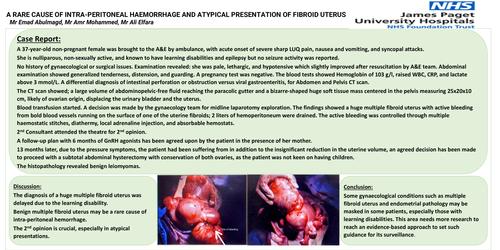
A 37-year-old non-pregnant female was brought to the A&E by ambulance, with acute onset of severe sharp LUQ pain, nausea and vomiting, and syncopal attacks.
She is nulliparous, non-sexually active, and known to have learning disabilities and epilepsy but no seizure activity was reported.
No history of gynaecological or surgical issues. Examination revealed: she was pale, lethargic, and hypotensive which slightly improved after resuscitation by A&E team. Abdominal examination showed generalized tenderness, distension, and guarding. A pregnancy test was negative. The blood tests showed Hemoglobin of 103 g/l, raised WBC, CRP, and lactate above 3 mmol/L.
A differential diagnosis of intestinal perforation or obstruction versus viral gastroenteritis, for Abdomen and Pelvis CT scan.
The CT scan showed; a large volume of abdominopelvic-free fluid reaching the paracolic gutter and a bizarre-shaped huge soft tissue mass centered in the pelvis measuring 25x20x10 cm, likely of ovarian origin, displacing the urinary bladder and the uterus.
Blood transfusion started. A decision was made by the gynaecology team for midline laparotomy exploration. The findings showed a huge multiple fibroid uterus with active bleeding from bold blood vessels running on the surface of one of the uterine fibroids; 2 liters of hemoperitoneum were drained. The active bleeding was controlled through multiple haemostatic stitches, diathermy, local adrenaline injection, and absorbable hemostats.
2nd Consultant attended the theatre for 2nd opinion.
A follow-up plan with 6 months of GnRH agonists has been agreed upon by the patient in the presence of her mother.
13 months later, due to the pressure symptoms, the patient had been suffering from, in addition to the insignificant reduction in the uterine volume, an agreed decision has been made to proceed with a subtotal abdominal hysterectomy with conservation of both ovaries, as the patient was not keen on having children.
The histopathology revealed benign leiomyomas.
Discussion:
The diagnosis of a huge multiple fibroid uterus was delayed due to the learning disability.
Benign multiple fibroid uterus may be a rare cause of intra-peritoneal hemorrhage.
The 2nd opinion is crucial, especially in atypical presentations.
Conclusion:
Some gynaecological conditions such as multiple fibroid uterus and endometrial pathology may be masked in some patients, especially those with learning disabilities. This area needs more research to reach an evidence-based approach to set such guidance for its surveillance.