1,830 posters, 67 videos, 75 audios, 29 topics, 22 sessions, 4,727 authors, 1,697 institutions
ePostersLive by SciGen Technologies S.A. All rights reserved.
RCOG World Congress 2023
June 12 - 14, 2023 | London, UK

EP.0684
Pregnancy outcome complicated by chemotherapy-induced cardiomyopathy
Poster Presenter
Authors
Affiliations
Part of Topic
Maternal Medicine
Pregnancy outcome complicated by chemotherapy-induced cardiomyopathy
Anila Aravindan, Sadia Solaiman, Uzma Aziz
Department of Obstetrics and Gynecology
Abstract:
Introduction:
Cardiomyopathy is a group of disorders in which the heart muscle is structurally and functionally abnormal in the absence of other diseases that could cause observed myocardial abnormality. Chemotherapy-related cardiomyopathy has been reported in up to 5% of all cancer survivors and 9% of those exposed to anthracyclines in the modern world. A class of antineoplastic drugs known as anthracyclines was initially discovered and developed as antibiotics but found useful in the treatment of various cancers since the 1960s. Doxorubicin is often used today as a crucial component of chemotherapy regimens for a range of childhood and adult cancers, including leukemias, lymphomas, sarcomas, and breast cancer. Pre-existing medical issues can have a negative impact on women and their offspring.
The following case study demonstrates how a patient's decision can direct a challenging clinical scenario with multidisciplinary support resulting in a good outcome.
Case Summary:
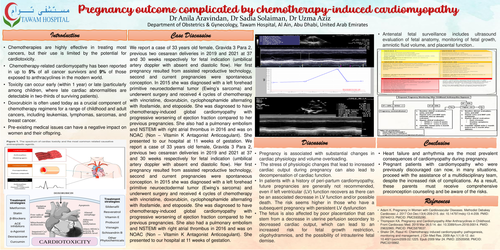
We report a case of 33 years old female, Gravida 3 Para 2, previous two cesarean deliveries in 2019 and 2021 at 37 and 30 weeks respectively for fetal indication (umbilical artery doppler with absent end diastolic flow). Her first pregnancy resulted from assisted reproductive technology, second and current pregnancies were spontaneous conception. In 2015 she was diagnosed with a left forehead primitive neuroectodermal tumor (Ewing’s sarcoma) and underwent surgery and received 4 cycles of chemotherapy with vincristine, doxorubicin, cyclophosphamide alternating with ifosfamide, and etoposide. She was compliant with follow-up and had no residual disease. However, she was diagnosed to have chemotherapy-induced global cardiomyopathy with progressive worsening of ejection fraction compared to her previous pregnancies. She also had a pulmonary embolism and NSTEMI with right atrial thrombus in 2016 and was on NOAC (Non – Vitamin K Antagonist Anticoagulant). She presented to our hospital at 11 weeks of gestation. The first echocardiography during pregnancy was reported as a globally hypokinetic left ventricle, severe left ventricle systolic dysfunction with an ejection fraction (EF) of 25-30%. A multidisciplinary meeting and expert opinion taken from three different tertiary hospitals advised the termination of pregnancy. However, she declined repeatedly and wanted to continue. The pregnancy was continued with regular follow-ups in the obstetric and cardiology unit. She was asymptomatic from a cardiac point of view. She was placed on multiple medications (aspirin 75mg OD, LMWH 40mg OD, bisoprolol 10mg OD, isosorbide mononitrate tablets 20mg, furosemide 40mg, hydralazine oral 12.5 mg BID , folic acid, multivitamin, and vitamin D) . At 27 weeks of gestation, scan showed fetal growth restriction and high umbilical artery doppler and at 29 weeks + 5 days of gestation noted to have absent end diastolic flow of the umbilical artery. She was admitted for betamethasone and CTG. After admission, CTG was suspicious, hence underwent an emergency cesarean section at 29 weeks + 6 days of gestation under spinal anesthesia. She delivered a baby girl, 1100 grams, APGAR scores of 8,9 and 9 at 1,5 and 10 minutes. Baby was admitted to NICU for further care. Postnatal recovery was uneventful. ECHO done post-delivery showed EF of 20 – 25% , global hypokinesia, Grade II diastolic dysfunction, moderate/severe tricuspid regurgitation with severe pulmonary hypertension 60-65 mmHg. She was discharged on Day 2 of surgery after 48 hours of observation on cardiac medications and follow-up in 1 week.
Conclusion:
Heart failure and arrhythmia are the most prevalent consequences of cardiomyopathy during pregnancy. Pregnant patients with cardiomyopathy who were previously discouraged can now, in many situations, proceed with the assistance of a multidisciplinary team, despite the increased risk of complications. As a result, these parents must receive comprehensive preconception counseling and be aware of the risks.