1,830 posters, 67 videos, 75 audios, 29 topics, 22 sessions, 4,727 authors, 1,697 institutions
ePostersLive by SciGen Technologies S.A. All rights reserved.
RCOG World Congress 2023
June 12 - 14, 2023 | London, UK

EP.0680
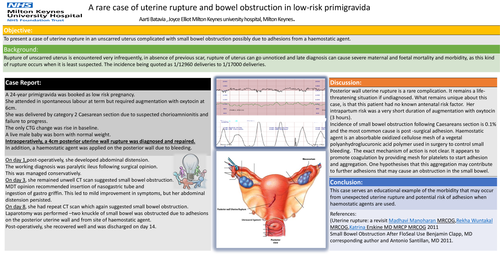
A rare case of uterine rupture and bowel obstruction in low-risk primigravida
Poster Presenter
Authors
Affiliations
Part of Topic
Labour Ward Management
A rare case of uterine rupture and bowel obstruction in low-risk primigravida
-Aarti Batavia, Joyce Elliot Milton Keynes university hospital, Milton Keynes.
Objective:
To present a case of uterine rupture in an unscarred uterus complicated with small bowel obstruction possibly due to adhesions from a haemostatic agent.
Background:
Rupture of unscarred uterus is encountered very infrequently, in absence of previous scar, rupture of uterus can go unnoticed and late diagnosis can cause severe maternal and foetal mortality and morbidity, as this kind of rupture occurs when it is least suspected. The incidence being quoted as 1/12960 deliveries to 1/17000 deliveries.
Case Report:
A 24-year primigravida was booked as low-risk pregnancy.
She attended in spontaneous labour at term but required augmentation with oxytocin at 6cm.
She was delivered by category 2 Caesarean section due to suspected chorioamnionitis and failure to progress.
The only CTG change was a rise in the baseline.
A live male baby was born with normal weight.
Intraoperatively, a 4cm posterior uterine wall rupture was diagnosed and repaired.
In addition, a haemostatic agent was applied to the posterior wall due to bleeding.
On day 1,post-operatively, she developed abdominal distension.
The working diagnosis was paralytic ileus following surgical opinion.
This was managed conservatively.
On day 3, she remained unwell CT scan suggested small bowel obstruction.
MDT opinion recommended insertion of nasogastric tube and
ingestion of gastrografin. This led to mild improvement in symptoms, but her abdominal distension persisted.
On day 8, she had repeat CT scan which again suggested small bowel obstruction. Laparotomy was performed –two knuckle of small bowel was obstructed due to adhesions on the posterior uterine wall and from site of haemostatic agent.
Post-operatively, she recovered well and was discharged on day 14.
Discussion:
Posterior wall uterine rupture is a rare complication. It remains a life-threatening situation if undiagnosed. What remains unique about this case, is that this patient had no known antenatal risk factor. Her intrapartum risk was a very short duration of augmentation with oxytocin (3 hours).
Incidence of small bowel obstruction following Caesareans section is 0.1% and the most common cause is post -surgical adhesion. Haemostatic agent is an absorbable oxidized cellulose mesh of a vegetal polyanhydroglucuronic acid polymer used in surgery to control small bleeding. The exact mechanism of action is not clear. It appears to promote coagulation by providing mesh for platelets to adhere and aggregate. One hypothesises is that the aggregation may contribute to further adhesions that may cause an obstruction in the small bowel.
Conclusion:
This case serves an educational example of the morbidity that may occur from unexpected uterine rupture and potential risk of adhesion when haemostatic agents are used.
References:
(Uterine rupture: a revisit Madhavi Manoharan MRCOG,Rekha Wuntakal MRCOG,Katrina Erskine MD MRCP MRCOG 2011
Small Bowel Obstruction After FloSeal Use Benjamin Clapp, MD corresponding author and Antonio Santillan, MD 2011.