1,830 posters, 67 videos, 75 audios, 29 topics, 22 sessions, 4,727 authors, 1,697 institutions
ePostersLive by SciGen Technologies S.A. All rights reserved.
RCOG World Congress 2023
June 12 - 14, 2023 | London, UK

EP.0673
Novel agonists of the Piezo1 mechanosensing ion channel for placental drug development
Poster Presenter
Authors
Muath Bajarwan, Marjolaine Debant, Charlotte Revill, Gregory Parsonage, Richard Foster, Nigel Simpson, Lara Morley, David Beech
Affiliations
Leeds Institute of Cardiovascular and Metabolic Medicine, School of Medicine, University of Leeds, School of Chemistry, University of Leeds, Division of Women's and Children's Health, School of Medicine, University of Leeds
Part of Topic
Fetal Medicine
Novel agonists of the Piezo1 mechanosensing ion channel for placental drug development
-Background:
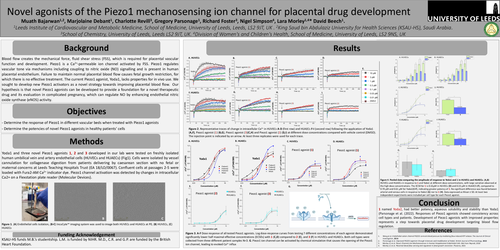
Blood flow creates the mechanical force, fluid shear stress (FSS), which is required for placental vascular function and development. Piezo1 is a Ca2+-permeable ion channel activated by FSS. Piezo1 regulates vascular tone via mechanisms including coupling to nitric oxide (NO) signalling and is present in human placental endothelium. Failure to maintain normal placental blood flow causes fetal growth restriction, for which there is no effective treatment. The current Piezo1 agonist, Yoda1, lacks properties for in vivo use. We sought to develop new Piezo1 activators as a novel strategy towards improving placental blood flow. Our hypothesis is that novel Piezo1 agonists can be developed to provide a foundation for a novel therapeutic drug and its evaluation in complicated pregnancy, which can regulate NO by enhancing endothelial nitric oxide synthase (eNOS) activity.
-Objectives
Determine the response of Piezo1 in different vascular beds when treated with Piezo1 agonists
Determine the potencies of novel Piezo1 agonists in healthy patients’ cells
-Methods
Yoda1 and three novel Piezo1 agonists 1, 2 and 3 developed in our lab were tested on freshly isolated human umbilical vein and artery endothelial cells (HUVECs and HUAECs) (Fig1). Cells were isolated by vessel cannulation for collagenase digestion from patients delivering by caesarean section with no fetal or maternal concerns at Leeds Teaching Hospitals Trust (EA 18/LO/0067). Confluent cells at passages 2-5 were loaded with Fura2-AM Ca2+ indicator dye. Piezo1 channel activation was detected by changes in intracellular Ca2+ on a Flexstation plate reader (Molecular Devices).
-Conclusion
1 named Yoda2, had better potency, aqueous solubility and stability than Yoda1 (Parsonage et al. (2022). Responses of Piezo1 agonists showed consistency across cell types and patients. Development of Piezo1 agonists with improved properties represents a step towards placental drug development targeting blood flow regulation.