1,830 posters, 67 videos, 75 audios, 29 topics, 22 sessions, 4,727 authors, 1,697 institutions
ePostersLive by SciGen Technologies S.A. All rights reserved.
RCOG World Congress 2023
June 12 - 14, 2023 | London, UK

EP.0665
Epidemiology and Risk factors for Multi-drug Resistant Bacterial Urinary Tract Infections
Poster Presenter
Authors
Affiliations
Part of Topic
Hot Topics (Emerging research/issues) in Obstetrics
Epidemiology and Risk Factors for Multi-drug Resistant Bacterial Urinary Tract Infections among Pregnant Women in Qatar
Sufia Athar1, Adila Shaukat2, Lolwa Mohammad Ansari1
Department of Obstetrics and Gynecology, AWH, Qatar
Department of Infectious Diseases, AWH, Qatar
Abstract
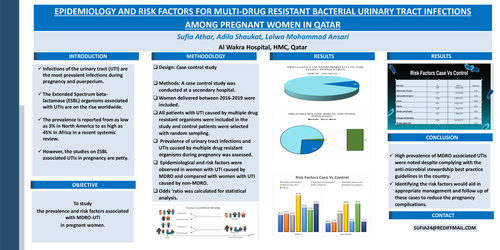
Objective: Infections caused by multiple drug-resistant organisms are on the rise worldwide. Urinary tract infections (UTI) are one of the commonest infections in pregnancy. These infections are known to be associated with poor feto-maternal outcomes. UTIs caused by drug-resistant organisms (MDRO) have a higher likelihood of complications like pyelonephritis and sepsis in the mother and adverse neonatal outcomes. Hence a clinical survey was conducted to assess the epidemiology and risk factors associated with UTIs caused by drug-resistant organisms.
Design: A case-control study
Methods: A case-control study was conducted at a secondary hospital. Women delivered between 2016-2019 were included. All patients with UTI caused by multiple drug-resistant organisms were included in the study and control patients were selected with random sampling. The prevalence of urinary tract infections and UTIs caused by multiple drug-resistant organisms during pregnancy was assessed. Epidemiological and risk factors were observed in women with UTI caused by MDRO and compared with women with UTI caused by non-MDRO. The odds ‘ratio was calculated for statistical analysis.
Results: 21520 women delivered between 2016-2019. The overall prevalence of UTI in pregnancy was 1.88%. Out of these 11.88% had UTIs caused by drug-resistant organisms. 72.92% of these were caused by extended-spectrum β-lactamases producing Escherichia coli. Nulliparity, maternal age of more than 30 years and infections in the third trimester were identified as epidemiological factors for MDRO-associated UTIs. Body mass index of more than 30 kg/m2 (OR-3.13, 95% CI-1.51-6.51, P<0.05), maternal anemia (OR-4.26, 95% CI-2.05-8.85,P<0.05), multiple catheterizations in labor (OR-2.27, 95% CI-1.03-5.02,P<0.05) and prolonged catheterization(OR-2.23, 95% CI-1.03-4.81,P<0.05) had positive co-relation with MDRO UTIs. Gestational diabetes and multiple vaginal examinations in labour were noted to have a higher likelihood for MDRO UTIs but the results were not statistically significant(p<0.05).
Conclusions: High prevalence of MDRO-associated UTIs was noted despite complying with the anti-microbial stewardship best practice guidelines in the country. Identifying the risk factors would aid in the appropriate management and follow-up of these cases to reduce pregnancy complications.