1,830 posters, 67 videos, 75 audios, 29 topics, 22 sessions, 4,727 authors, 1,697 institutions
ePostersLive by SciGen Technologies S.A. All rights reserved.
RCOG World Congress 2023
June 12 - 14, 2023 | London, UK

EP.0662
Postpartum glucose testing in women who were diagnosed with gestational diabetes
Poster Presenter
Authors
Affiliations
Part of Topic
Maternal Medicine
POSTPARTUM GLUCOSE TESTING IN WOMEN WHO WERE DIAGNOSED WITH GESTATIONAL DIABETES
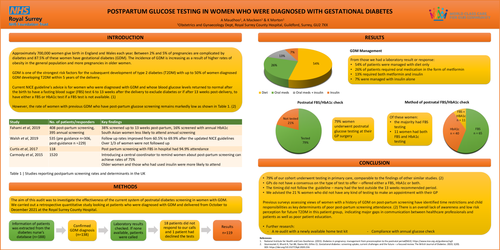
Approximately 700,000 women give birth in England and Wales each year. Between 2% and 5% of pregnancies are complicated by diabetes and 87.5% of these women have gestational diabetes (GDM). The incidence of GDM is increasing as a result of higher rates of obesity in the general population and more pregnancies in older women.
GDM is one of the strongest risk factors for the subsequent development of type 2 diabetes (T2DM) with up to 50% of women diagnosed GDM developing T2DM within 5 years of the delivery.
Current NICE guideline’s advice is for women who were diagnosed with GDM and whose blood glucose levels returned to normal after the birth to have a fasting blood sugar (FBS) test 6 to 13 weeks after the delivery to exclude diabetes or if after 13 weeks post-delivery, to have either a FBS or HbA1c test if a FBS test is not available. (1)
However, the rate of women with previous GDM who have post-partum glucose screening remains markedly low. (2)
The aim of this audit was to investigate the effectiveness of the current system of postnatal diabetes screening in women with GDM.
We carried out a retrospective quantitative study looking at patients who were diagnosed with GDM and delivered from October to December 2021 at the Royal Surrey County Hospital.
From those we had a laboratory result or response:
79% women underwent postnatal glucose testing at their GP surgery
Of these women:
Previous surveys assessing views of women with a history of GDM on post-partum screening have identified time restrictions and child responsibilities as key determinants of poor post-partum screening attendance. (2) There is an overall lack of awareness and low risk perception for future T2DM in this patient group, indicating major gaps in communication between healthcare professionals and patients as well as poor patient education.
- A re-audit with a newly available home test kit - Compliance with annual glucose check