1,830 posters, 67 videos, 75 audios, 29 topics, 22 sessions, 4,727 authors, 1,697 institutions
ePostersLive by SciGen Technologies S.A. All rights reserved.
RCOG World Congress 2023
June 12 - 14, 2023 | London, UK

EP.0650
Identification of Babies with Fetal Growth Restriction
Poster Presenter
Authors
Affiliations
Part of Topic
High Risk Pregnancy
Identification of Babies with Fetal Growth Restriction
Dr. Elizabeth Nevins & Dr. Ruth Thompson
University Hospital of North Durham
Objective
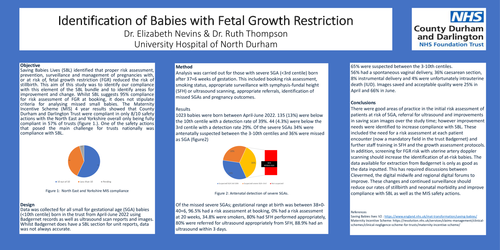
Saving Babies Lives (SBL) identified that proper risk assessment, prevention, surveillance and management of pregnancies with, or at risk of, fetal growth restriction (FGR) reduced the risk of stillbirth. This aim of this study was to identify our compliance with this element of the SBL bundle and to identify areas for improvement and change. Whilst SBL suggests 95% compliance for risk assessment of FGR at booking, it does not stipulate criteria for analysing missed small babies. The Maternity Incentive Scheme (MIS) 4 year results showed that County Durham and Darlington Trust were compliant in only 8/10 safety actions with the North Eastand Yorkshire overall only being fully compliant in 57% of trusts (figure 1.). One of the safety actions that posed the main challenge for trusts nationally was compliance with SBL.
Design
Data was collected for all small for gestational age (SGA) babies (<10th centile) born in the trust from April-June 2022 using Badgernet records as well as ultrasound scan reports and images. Whilst Badgernet does have a SBL section for unit reports, data was not always accurate.
Method
Analysis was carried out for those with severe SGA (<3rd centile) born after 37+6 weeks of gestation. This included booking risk assessment, smoking status, appropriate surveillance with symphysis-fundal height (SFH) or ultrasound scanning, appropriate referrals, identification of missed SGAs and pregnancy outcomes.
Results
1023 babies were born between April-June 2022. 135 (13%) were below the 10th centile with a detection rate of 39%. 44 (4.3%) were below the 3rd centile with a detection rate 29%. Of the severe SGAs 34% were antenatally suspected between the 3-10th centiles and 36% were missed as SGA (figure2)Of the missed severe SGAs; gestational range at birth was between 38+0-40+6, 96.5% had a risk assessment at booking, 0% had a risk assessment at 20 weeks, 34.8% were smokers, 80% had SFH performed appropriately, 80% were referred for ultrasound appropriately from SFH, 88.9% had an ultrasound within 3 days.65% were suspected between the 3-10th centiles.56% had a spontaneous vaginal delivery, 36% caesarean section, 8% instrumental delivery and 4% were unfortunately intrauterine death (IUD). Images saved and acceptable quality were 25% in April and 66% in June.
Conclusions
There were good areas of practice in the initial risk assessment of patients at risk of SGA, referral for ultrasound and improvements in saving scan images over the study time; however improvement needs were identified to increase compliance with SBL. These included the need for a risk assessment at each patient encounter (now a mandatory field in the trust Badgernet) and further staff training in SFH and the growth assessment protocols. In addition, screening for FGR risk with uterine artery doppler scanning should increase the identification of at-risk babies. The data available for extraction from Badgernet is only as good as the data inputted. This has required discussions between Clevermed, the digital midwife and regional digital forums to improve. These changes and continued surveillance should reduce our rates of stillbirth and neonatal morbidity and improve compliance with SBL as well as the MIS safety actions.