1,830 posters, 67 videos, 75 audios, 29 topics, 22 sessions, 4,727 authors, 1,697 institutions
ePostersLive by SciGen Technologies S.A. All rights reserved.
RCOG World Congress 2023
June 12 - 14, 2023 | London, UK

EP.0646
What is the ideal treatment for Covid19 positive pregnant women?
Poster Presenter
Authors
Affiliations
Part of Topic
Pandemic and impact of Covid/Infectious Diseases
Video
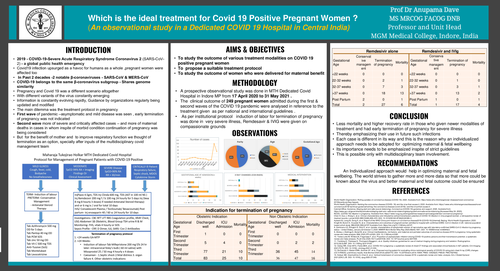
Which is the ideal treatment for Covid 19 Positive Pregnant Women ?
(An observational study in a Dedicated COVID 19 Hospital in Central India)
Prof Dr Anupama Dave
MS MRCOG FACOG DNB
Professor and Unit Head
MGM Medical College, Indore, India
Introduction
TOTAL 249
An Individualized approach would help in optimizing maternal and fetal wellbeing. The world strives to gather more and more data so that more could be known about the virus and better maternal and fetal outcome could be ensured
References
World Health Organization. Rolling updates on coronavirus disease (COVID-19). 2020. Available from: https://www.who.int/emergencies/ diseases/novel-coronavirus-2019/events-as-they-happen.
World Health Organization. Naming the coronavirus disease (COVID- 19) and the virus that causes it. 2020. Available from: https:// www.who.int/emergencies/diseases/novel-coronavirus-2019/ technical-guidance/naming- the-coronavirus-disease-(covid-2019)- and-the-virus-that-causes-it.
Cabinet Office. Guidance. Staying alert and safe (social distancing). Coronavirus (COVID-19) guidance and support. 2020. Available from: https://www.gov.uk/government/publications/staying-alert-and- safe-social-distancing/staying-alert-and-safe-social-distancing [Accessed May 24, 2020].
RCOG. (COVID-19) infection in pregnancy. Available from: https:// www.rcog.org.uk/en/guidelines-research-services/guidelines/ coronavirus-pregnancy/.
Chen H, Guo J, Wang C, et al. Clinical characteristics and intrauterine vertical transmission potential of COVID-19 infection in nine pregnant women: a retrospective review of medical records. Lancet 2020;395(10226):809–815. DOI: 10.1016/S0140-6736(20)30360-3.
Aylward B, Liang W, Dong X, et al. Report of the WHO China joint mission on coronavirus disease2019 (COVID-19) [Internet]. Beijing: World Health Organisation; 2020.
Knight M, Bunch K, Vousden N, et al. Characteristics and outcomes of pregnant women admitted to hospital with confirmed SARS- CoV-2 infection in UK: national population based cohort study. BMJ2020;369:m2107 Available from: https://doi.org/10.1136/bmj.m2107.
8. Zambrano LD, Ellington S, Strid P, et al. Update: characteristics of symptomatic women of reproductive age with laboratory-confirmed SARS-CoV-2 infection by pregnancy status – United States, January 22-October 3, 2020. MMWR Morb Mortal Wkly Rep 2020;69(44):1641. DOI: 10.15585/mmwr.mm6944e3.
9. Allotey J, Stallings E, Bonet M, et al. Clinical manifestations, risk factors, and maternal and perinatal outcomes of coronavirus disease 2019 in pregnancy: living systematic review and meta-analysis. BMJ 2020;370:m3320. DOI: 10.1136/bmj.m3320.
10. Yanes-Lane M, Winters N, Fregonese F, et al. Proportion of asymptomatic infection among COVID-19 positive persons and their transmission potential: a systematic review and meta-analysis. PLoS One 2020;15(11):e0241536. DOI: 10.1371/journal.pone.0241536.
11. Tremblay E, Thérasse E, Thomassin-Naggara I, et al. Quality initiatives: guidelines for use of medical imaging during pregnancy and lactation. Radiographics 2012;32(3):897. DOI: 10.1148/rg.323115120.
12. Oshay RR, Chen MYC, Fields BKK, et al. COVID-19 in pregnancy: a systematic review of chest CT findings and associated clinical features in 427 patients. Clin Imaging 2021;75:75. DOI: 10.1016/j. clinimag.2021.01.004.
13. De Sanctis V, Bedair EMA, Soliman AT, et al. Proposed scoring system for evaluating clinico-radiological severity of COVID-19 using plain chest X-ray (CXR) changes (CO X-RADS): preliminary results. Acta Biomed 2020;91(4):e2020172. DOI: 10.23750/abm.v91i4.10664. PMID: 33525220; PMCID: PMC7927462.
14. Kotlyar AM, Grechukhina O, Chen A, et al. Vertical transmission of coronavirus disease 2019: a systematic review and meta- analysis. Am J Obstet Gynecol 2021;224(1):35. DOI: 10.1016/j. ajog.2020.07.049.
1