1,830 posters, 67 videos, 75 audios, 29 topics, 22 sessions, 4,727 authors, 1,697 institutions
ePostersLive by SciGen Technologies S.A. All rights reserved.
RCOG World Congress 2023
June 12 - 14, 2023 | London, UK

EP.0636
Does delays in Induction of labour cause harm?
Poster Presenter
Authors
Anuradha Sajja, Sharon Morad, Nicola Farmer, Lamya Alkadoushi, Komal Bhatt, Meenu Priyadarshini
Affiliations
Part of Topic
Hot Topics (Emerging research/issues) in Obstetrics
Introduction
A recent national survey demonstrated that delays during the process of induction of labour are common in current UK practice. There are no published data on the consequences of delays between completion of cervical ripening and transfer to labour ward.
Methods
We conducted retrospective observational study as part of quality improvement work in large maternity hospital in England. Anonymised data was obtained from the electronic patient records for 824 women who underwent induction of labour during January, August, and September 2020 and February 2021.
Inclusion criteria: Women having induction of labour during study period.
Exclusion criteria: Women in spontaneous labour or elective caesarean section.
Chi-squared test and Chi-squared test for linear trend was used for statistical significance.
Results
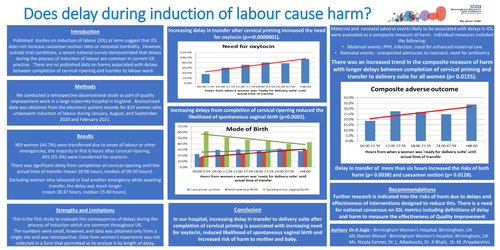
There was significant delay from completion of cervical ripening until the actual time of transfer (mean 18:06 hours, median of 05:50 hours).
369 women (44.7%) were transferred due to labour or other emergencies, the majority in first 6 hours after cervical ripening, 455 (55.3%) were transferred for oxytocin.
In the oxytocin group the delay was much longer (mean 26:37 hours, median 15:40 hours). Longer delay in transfer was associated with an increased need for oxytocin (p=<0.0000001) and reduction in spontaneous birth (p=0.0002).
A composite adverse outcome (Maternal: PPH, infection, enhanced maternal care; Neonatal: admissions to NNU, need for antibiotics) was identified to assess risk of harm. There was an increased trend in harm with longer delays for all women (p= 0.0155), including those transferred for ARM/oxytocin (p=0.03648).
Delay >6 hours increased the risk of harm (p= 0.0038) and caesarean section (p= 0.0128).
Strengths
This is the first study to evaluate the consequences of delays during the process of induction which are common throughout UK.
Limitations
The numbers were small, data was obtained only from a single site and retrospective. Data from patient experience was not collected in a form that permitted us to analyse it by length of delay.
Conclusion
In our hospital delays in IOL from completion of cervical ripening until transfer for oxytocin was associated with reduced likelihood of spontaneous vaginal birth and increased likelihood of maternal and neonatal harm.
Recommendations
Further research is indicated into the risks of harm due to delays and effectiveness of interventions designed to reduce this. There is a need for national consensus on IOL metrics including definitions of delay and harm to measure the effectiveness of QI projects nationally.