1,830 posters, 67 videos, 75 audios, 29 topics, 22 sessions, 4,727 authors, 1,697 institutions
ePostersLive by SciGen Technologies S.A. All rights reserved.
RCOG World Congress 2023
June 12 - 14, 2023 | London, UK

EP.0635
Placenta praevia: audit of management and pregnancy outcomes at a tertiary Hospital
Poster Presenter
Authors
Corha Andrei, Diane Nzelu, Freweini Tesfai, Guldzhan Vorona, George Attilakos
Affiliations
Part of Topic
High Risk Pregnancy
Placenta praevia: audit of management and pregnancy outcomes at a tertiary Hospital
Dr Corha Andrei 1, Dr Diane Nzelu 1, Dr Freweini Tesfai 1, Dr Guldzhan Vorona 1, Mr George Attilakos 1
(1 - University College London Hospital, London, United Kingdom)
Maternal risk factors associated with development of placenta praevia (PP) are increasing in prevalence.
In recognition of this, the RCOG published new recommendations (2018) for the diagnosis and management of women with low lying placenta (LLP) or PP, recommending earlier elective delivery of women with complicated PP between 34 to 36 weeks.
Audit management and pregnancy outcomes of women with PP at their mid-trimester fetal anomaly scan using the RCOG guidelines as the gold standard.
Inclusion criteria included:
PP was defined as a placenta lying directly over the internal os or LLP if within 20mm. PP/LLP was considered complicated if there were previous hospital admissions with APH.
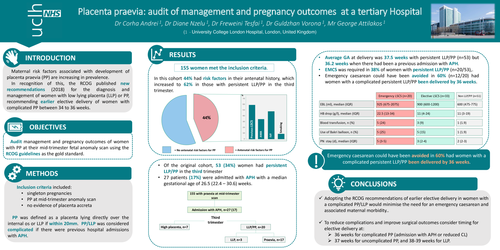
In this cohort 44% had risk factors in their antenatal history, which increased to 62% in those with persistent LLP/PP in the third trimester.
Emergency caesarean could have been avoided in 60% had women with a complicated persistent LLP/PP been delivered by 36 weeks.