1,830 posters, 67 videos, 75 audios, 29 topics, 22 sessions, 4,727 authors, 1,697 institutions
ePostersLive by SciGen Technologies S.A. All rights reserved.
RCOG World Congress 2023
June 12 - 14, 2023 | London, UK

EP.0631
Emergency Cervical Cerclage: Dose the Technique Matter? A Single Institute Experience
Part of Topic
High Risk Pregnancy
INTRODUCTION
Cervical insufficiency (painless cervical dilatation) with the inability of the uterine cervix to retain a pregnancy in the second trimester,1 affects 1% of all pregnancies and 8% of women with recurrent mid-trimester losses.2Emergency cerclage (EC) could be a salvage measure in the case of premature cervical dilatation with exposed fetal membranes in the vagina2 and can be considered up to 26+6 weeks of gestation.3 Reported techniques so far, describe pushing the fetalmembranes using Foley’s catheter or swabs before insertion of cerclage.4 It is a surgically challenging operation, that could fail in cases of the presence of bulging fetal membranes through a cervical dilation that is narrower than the diameter of the dilated membranes.4 Additionally, handling the membranes could increase complications such as rupture fetalmembranes.2,4
AIMS AND OBJECTIVES
METHOD
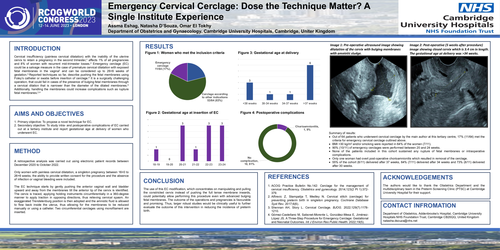
A retrospective analysis was carried out using electronic patient records between December 2020 to October 2022.
Only women with painless cervical dilatation, a singleton pregnancy between 16+0 to 26+6 weeks, the ability to provide written consent for the procedure and the absence of infection or vaginal bleeding were included.
The EC technique starts by gently pushing the anterior vaginal wall and bladder upward and away from the membranes till the anterior lip of the cervix is identified. The cervix is traced, applying holding instruments circumferentially in a 360-degree manner to apply traction in opposing directions, thus relieving cervical spasm. An exaggerated Trendelenburg position is then adopted and the amniotic fluid is allowed to flow back inside the uterus, thus allowing for the membranes to be reduced manually or using a catheter. Two circumferential cerclages using monofilament are inserted.
RESULTS
Summary of results:
CONCLUSION
The use of this EC modification, which concentrates on manipulating and pulling the constricted cervix instead of pushing the full tense membrane inwards, could potentially allow performing this procedure even with advanced bulging fetal membranes. The outcome of the operations and pregnancies is favourable and promising. Thus, larger robust studies would be clinically useful to further evaluate the outcome of this intervention in reducing the incidence of preterm birth.
REFERENCES
ACKNOWLEDGEMENTS
The authors would like to thank the Obstetrics Department and the multidisciplinary team in the Preterm Screening Clinic (PTSC) at Cambridge University Hospital for their support.
CONTACT INFROMATION
Department of Obstetrics, Addenbrooke’s Hospital, Cambridge University Hospitals NHS Foundation Trust, Cambridge CB20QQ, United Kingdom
natasha.dsouza@nhs.net