1,830 posters, 67 videos, 75 audios, 29 topics, 22 sessions, 4,727 authors, 1,697 institutions
ePostersLive by SciGen Technologies S.A. All rights reserved.
RCOG World Congress 2023
June 12 - 14, 2023 | London, UK

EP.0619
Refractory Post-partum Haemorrhage in a County Referral Hospital, Coastal Region of Kenya.
Poster Presenter
Part of Topic
Labour Ward Management
REFRACTORY POST-PARTUM HAEMORRHAGE IN A COUNTY REFERRAL HOSPITAL, COASTAL REGION OF KENYA.
Ms. Naima Shatry 1, Dr. Urvashi Agarwal 2, Dr. Fatuma Hamid3, Dr. Nawal Aliyan2
1Royal Devon University Hospital, United Kingdom.
2Coast General Teaching and Referral Hospital, Mombasa, Kenya.
3Monash Health, Melbourne, Australia
OBJECTIVE:
Post-partum haemorrhage (PPH) remains one of the leading causes of maternal mortality globally. As recommended by the World Health Organization, first line treatment measures for PPH include: uterine massage, uterotonics, IV fluids and tranexamic acid use. Despite this, there are still women who do not respond to first line treatment. Women with refractory PPH contribute significantly to maternal mortality and severe morbidity. This study aimed to determine the causes and measures taken for the treatment of women with refractory PPH at the County Referral Hospital, in the Coastal region of Kenya.
BACKGROUND:
Postpartum haemorrhage (PPH) is the leading cause of maternal mortality in the world, with a prevalence rate of approximately 6% (1). As defined by World Health Organization, PPH is a blood loss of 500mls or more within 24 hours after birth, while severe PPH is defined as a blood loss of 1000mls or more within 24 hours (2). PPH is associated with nearly 20% of all maternal deaths globally, and is the leading cause of maternal mortality in low-income countries (3). Sub-Saharan Africa and Southern Asia accounted for approximately 86% of the estimated global number of maternal deaths in 2017 (254 000) with sub-Saharan Africa alone accounting for roughly 66% (196 000) (4).
Although the risk factors for PPH are widely recognised, a majority of women with PPH, have no identifiable risk factors (5,6,7). Uterine atony is the most common cause of PPH, but genital tract trauma, retained placental tissue, or maternal coagulation disorders are also known to cause PPH (7). Amongst the women who experience and survive PPH, severe anaemia is a common consequence – affecting about 11% of the 14 million women who experience PPH each year (8).
The majority of PPH-associated complications could be prevented by the use of prophylactic uterotonics; the World Health Organization has recommended the use of an effective uterotonic for the prevention of PPH in the third stage of labour for all births (for instance, oxytocin (10 IU, IM/IV) ) (10). Other agents like tranexamic acid, and IV fluids have been used in addition to uterotonics in the first response and treatment of PPH (11). The timely use of these uterotonics may reduce the need for further interventions (12,13). Even though there are published recommendations on the prevention and treatment of PPH, adherence to these is often poor (14). The use of ‘care bundles’ have been investigated in order to increase the quality and efficiency of care delivery for the treatment of PPH (15).
Refractory PPH has been defined as a condition in which women continue to bleed despite first line treatment (13). In refractory PPH, additional measures like additional uterotonics, uterine balloon tamponade and surgical interventions may be used including compressive sutures, artery ligation and hysterectomy. These cases of refractory PPH, represent a small, but relevant group of women who account for a large proportion of the PPH-associated mortality and severe morbidity burden (13).
In a secondary analysis of the CHAMPION trial by Widmer et al, it was shown that 16.2% of the women receiving uterotonics as first‐line PPH treatment did not respond to such treatment and received additional interventions (13). This analysis also revealed that women with refractory PPH had a different pattern of PPH causes compared with those with first‐line treatment responsive PPH: the relative contribution of atony in refractory PPH was reduced from 53.2% (in the responsive group) to 31.2% (refractory PPH group) while genital trauma was increased from 12.8% (responsive group) to 28% (refractory PPH group) (13). This finding is suggestive of the need for improved management in cases of refractory PPH. Further research to understand the contribution of refractory PPH to maternal mortality and severe morbidity in Kenya is needed. This is in order to be able to make the necessary changes in healthcare processes and better target implementation packages aimed at preventing PPH associated morbidity and mortality.
RESULTS:
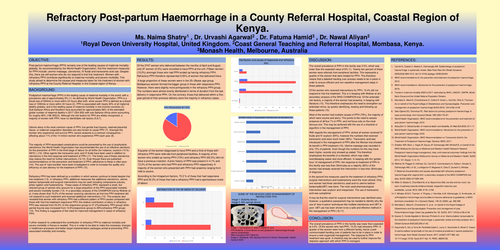
Of the 2747 women who delivered between the months of April and August, only 97 women (3.5%) were recorded to have PPH at the unit. Fifteen women (15.2%) amongst those who had PPH ended up having refractory PPH. Refractory PPH therefore represented 0.55% of women that delivered there. A large proportion of these women were in the 25–29year age group. Multiparous women formed the bigger group in those with responsive PPH. However, there were slightly more primigravids in the refractory PPH group. The numbers were almost evenly distributed in terms of duration from the last delivery in responsive PPH. On the contrary, those that delivered within a five-year period of their previous delivery were the majority in refractory cases.
A quarter of the women diagnosed to have PPH and a third of those with refractory PPH were referrals from peripheral facilities. A majority of the women who ended up having PPH (73%) and refractory PPH (93.3%) did not have a previous c/section. A prior history of PPH was present in 4.1% and 13.3% of the women who had PPH and refractory PPH respectively. A majority of the women who presented with PPH had anaemia ranging from mild to severe. According to the intrapartum factors, 72.2 % of those that had responsive PPH and 33.3% of those that had a refractory PPH had a spontaneous onset of labour.
DISCUSSION:
The overall prevalence of PPH in this facility was 3.5%, which was lower than the expected value of 6% (1). Twenty two percent of these women were referrals from peripheral facilities. This represents a quarter of the women that were treated for PPH. This therefore means that a detailed handing over process needs to be in place in order to ensure efficient and non-repetitive management steps in these patients.
Of the women who received interventions for PPH, 15.4% did not respond to first line treatment. This is in keeping with Widmer et al’s secondary analysis of the WHO CHAMPION trial. Of the antenatal risk factors, a majority of the women had anaemia, in keeping with literature (15). This therefore emphasizes the need to strengthen our antenatal clinics, by quickly identifying, treating and following-up these patients (15). Most of the women had multiple causes of PPH (76%), the majority of which were trauma and atony. This points to the need to assess presence of all four T’s in PPH, and not focus only on the most obvious one. This may be achieved with the use of a checklist or algorithm in the management of PPH.
With regards the management of PPH, almost all women received IV fluids and IV oxytocin (94%), however the numbers that received tranexamic acid were much lower (39%). Tranexamic acid was introduced in the management of PPH after the Woman trial showed its benefit in PPH treatment (10). Uterine massage was recorded in only 13% of patients. Even though the numbers for this may have been higher, records only showed as stated. This therefore emphasises the benefits of a checklist, which may make recordkeeping easier and more efficient. In keeping with the ‘golden hour’ of management of PPH, the response to treatment of PPH in this facility was less than 30minutes as a majority (93%) of the women had already received first intervention in less than 30minutes of diagnosis.
In the second line measures used for the treatment of refractory PPH, surgical interventions and hysterectomy were the most utilized. Only one woman had three uterotonics used and no uterine balloon tamponade (UBT) was done. The most used pharmacological intervention was oxytocin and misoprostol. The use of tranexamic acid was suboptimal. It may be that the need for surgical interventions was identified early, however, a qualitative assessment may be needed to identify why the use of ‘less invasive’ techniques like multiple uterotonics and UBT is poor. UBT use has been shown to be a safe and effective method in the management of PPH (16,17).
CONCLUSION:
The overall prevalence of PPH in this facility was lower than expected at 3.5%. Of the women who had PPH, 15.2% had refractory PPH. A quarter of the women were from a different facility, hence a well communicated handing over of patients has to be in place in order to ensure a well-organized management. The response to PPH treatment was quick. A checklist may be used to further improve the stepwise approach with which PPH is managed.
REFERENCES:
1. Carroli G, Cuesta C, Abalos E, Gulmezoglu AM. Epidemiology of postpartum haemorrhage: a systematic review. Best Pract Res Clin Obstet Gynaecol. 2008;22(6):999‐1012. doi:10.1016/j.bpobgyn.2008.08.004
2. WHO recommendations for the prevention and treatment of postpartum haemorrhage, 2012.
3. WHO recommendations: Uterotonics for the prevention of postpartum haemorrhage, 2018.
4. Trends in maternal mortality 2000 to 2017: estimates by WHO, UNICEF, UNFPA, World Bank Group and the United Nations Population Division.
5. Mavrides E, Allard S, Chandraharan E, Collins P, Green L, Hunt BJ, Riris S, Thomson AJ on behalf of the Royal College of Obstetricians and Gynaecologists. Prevention and management of postpartum haemorrhage BJOG 2016; 124:e106–e149.
6. Selo-Ojeme DO, Okonofua FE. Risk factors for primary postpartum haemorrhage. A case control study. Arch Gynecol Obstet 1997;259:179–87.
7. World Health Organisation. WHO recommendations for the prevention and treatment of post partum haemorrhage, 2012.
8. AbouZahr C: Global burden of maternal death and disability. Br Med Bull 2003, 67:1-11
9. World Health Organisation. WHO recommendations: Uterotonics for the prevention of post partum haemorrhage, 2018.
10. World Health Organization. WHO Recommendation on Tranexamic Acid for the Treatment of Postpartum Haemorrhage. Geneva: WHO; 2017.
11. Sheldon WR, Blum J, Vogel JP, Souza JP, Gulmezoglu AM, Winikoff B, on behalf of the WHO Multicountry Survey on Maternal and Newborn Health Research Network. Postpartum haemorrhage management, risks, and maternal outcomes: findings from the World Health Organization Multicountry Survey on Maternal and Newborn Health. BJOG 2014; 121 (Suppl. 1): 5–13.
12. Widmer M, Piaggio G, Hofmeyr GJ, Carroli G, Coomarasamy A, Gallos I, Goudar S, Gülmezoglu AM, Lin SL, Lumbiganon P, Mugerwa K, Owa O, Qureshi Z, Althabe F. Maternal characteristics and causes associated with refractory postpartum haemorrhage after vaginal birth: a secondary analysis of the WHO CHAMPION trial data. BJOG 2020;127:628–634.
13. Miller S, Abalos E, Chamillard M, et al. Beyond too little, too late and too much, too soon: A pathway towards evidence‐based, respectful maternity care worldwide. Lancet. 2016; 388: 2176– 2192.
14. F. Althabe, M.N.S. Therrien, V. Pingray, J. Hermida, A.M. Gülmezoglu, D. Armbruster, et al.Postpartum hemorrhage care bundles to improve adherence to guidelines: a WHO technical consultation Int J Gynecol Obstet, 148 (3) (2020), pp. 290-299
15. Mavrides E, Allard S, Chandrahan E, et al.: on behalf of the Royal College of Obstetricians and Gynaecologists. Prevention and management of post PartumHaemorrhage: Green top guideline No. 52. BJOG. 2017:124(5):e106-e149.
16. Suarez S, Conde-Agudelo A, Borovac-Pinheiro A, et al. Uterine balloon tamponade for the treatment of postpartum hemorrhage: a systematic review and meta-analysis. Am J Obstet Gynecol 2020;222:293.e1-52.
17. Gauchotte E, De La Torre M, Perdriolle-Galet E, Lamy C, Gauchotte G, Morel O. Impact of uterine balloon tamponade on the use of invasive procedures in severe postpartum hemorrhage. Acta Obstet Gynecol Scand. 2017 Jul;96(7):877-882. doi: 10.1111/aogs.13130. Epub 2017 Apr 12. PMID: 28295136.