1,830 posters, 67 videos, 75 audios, 29 topics, 22 sessions, 4,727 authors, 1,697 institutions
ePostersLive by SciGen Technologies S.A. All rights reserved.
RCOG World Congress 2023
June 12 - 14, 2023 | London, UK

EP.0613
Maternal plasma extracellular vesicles in pregnancies affected by early-onset Fetal Growth Restriction
Poster Presenter
Authors
Affiliations
Part of Topic
Fetal Medicine
Maternal plasma extracellular vesicle (EV) size and concentration in pregnancies affected by early-onset Fetal Growth Restriction (FGR)
Background : Extracellular vesicles (EVs) are nanoparticles thought to be involved in cell-to- cell communication. Despite their popularity in other fields, there remains a notable literature gap in their role in pregnancy. This study aimed to characterise maternal circulating EVs at the time of delivery in cases of early-onset Fetal Growth Restriction (FGR).
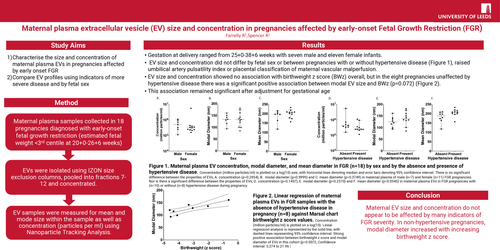
Method: Pre-delivery maternal plasma samples were collected from 18 pregnancies diagnosed with early-onset FGR (estimated fetal weight <3rd centile at 20+0-26+6 weeks). EVs were isolated using IZON size-exclusion columns and analysed for size and concentration by nanoparticle tracking analysis.
Results: Gestation at delivery ranged from 25+0-38+6 weeks with seven male and 11 female infants. EV size and concentration did not differ by fetal sex or between pregnancies with or without hypertensive disease, raised umbilical artery pulsatility index or placental classification of maternal vascular malperfusion. EV size and concentration showed no association with birthweight z score (BWz) overall, but in the eight pregnancies unaffected by hypertensive disease there was a significant positive association between modal EV size and BWz (p=0.072). This association remained significant after adjustment for gestational age.
Conclusion: Our results suggest several important pregnancy characteristics are not associated with differences in maternal EV size or concentration. In non-hypertensive pregnancies modal diameter increased with increasing birthweight z score. This association requires confirmation in a larger cohort, including appropriate-for-gestational-age pregnancies. Future work will explore the association between EV cargo and the placental transcriptome.