1,830 posters, 67 videos, 75 audios, 29 topics, 22 sessions, 4,727 authors, 1,697 institutions
ePostersLive by SciGen Technologies S.A. All rights reserved.
RCOG World Congress 2023
June 12 - 14, 2023 | London, UK

EP.0142
Multi-port (da Vinci) robotic myomectomy versus laparoscopic & laparotomic myomectomy: systematic review & meta-analysis
Poster Presenter
Authors
Elias Tsakos, Emmanouil Xydias, Apostolos C. Ziogas, Felice Sorrentino, Luigi Nappia, Nikolaos Vlachos, Angelos Daniilidis
Affiliations
Chair, Hellenic IRC, RCOG, EmbryoClinic IVF, University of Thessaly, School of Health Sciences, Faculty of Medicine, University of Foggia, Institute of Obstetrics and Gynecology, National and Kapodistrial University of Athens, School of Medicine, Department of Obstetrics and Gynaecology, Aristotle University of Thessaloniki, School of Medicine
Part of Topic
Benign Gynaecology
Multi-port (da Vinci) robotic myomectomy versus laparoscopic & laparotomic myomectomy: systematic review & meta-analysis
Introduction
Uterine fibroids are amongst the most prevalent gynaecological disorders, affecting up to 80% of women by the age of 50 years. Their clinical manifestations and associated infertility are a frequent source of emotional distress and exert a significant effect on overall quality of life. Robotic assisted laparoscopic myomectomy (RALM) with the use of the Da Vinci Surgical System, offers impressive 3D visualization capabilities, intuitive control, superior ergonomics and is currently the most advanced available option. In this systematic review we will examine whether these technical advantages improve RALM’s safety and effectiveness compared to conventional laparoscopic myomectomy (CLM) and abdominal myomectomy (AM).
Methods & Materials
This is a systematic review was conducted according to the PRISMA 2020 Statement and the formal research protocol was registered to the PROSPERO online database (CRD42023417412). Relevant studies were searched for on MEDLINE/PubMed, Web of Science and Scopus. The resulting initial study pool was thoroughly evaluated for relevance and all applicable data was extracted. Data on mean operation duration (MOD), estimated blood loss (EBL), hospitalization duration or length of stay (LOS), transfusion rate, complication rate, conversion to laparotomy rate were extracted and utilized for meta-analysis. The Newcastle-Ottawa Scale (NOS) for non-randomized studies was used for risk of bias assessment.
Results
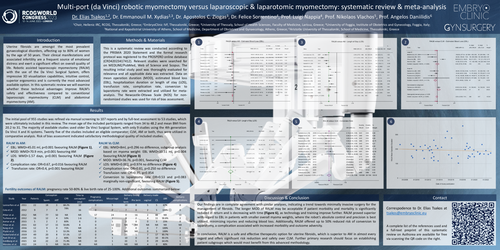
The initial pool of 955 studies was refined via manual screening to 107 reports and by full-text assessment to 53 studies, which were ultimately included in this review. The mean age of the included participants ranged from 34 to 48.2 and mean BMI from 20.2 to 31. The majority of available studies used older Da Vinci Surgical System, with only 9 studies using the 4th generation Da Vinci X and Xi systems. Twenty five of the studies included an eligible comparator; CLM, AM or both, thus were utilized in comparative analysis. Risk of bias assessment indicated satisfactory methodological quality of included studies.
RALM Vs AM:
EBL: WMD=45.01 ml, p<0.001 favouring RALM (Figure 1),
MOD: WMD=70.9 min, p<0.001 favouring AM
LOS: WMD=1.57 days, p<0.001 favouring RALM (Figure 2).
Complication rate: OR=0.67, p=0.016 favouring RALM
Transfusion rate: OR=0.4, p<0.001 favouring RALM
RALM Vs CLM:
EBL: WMD=8ml, p=0.296 no difference, subgroup analysis based on myoma weight: EBL WMD=33.51 ml, p=0.004 favouring RALM (Figure 3)
MOD: WMD=36.76, p<0.001, favouring CLM
LOS: WMD=0.002, p=0.974 no difference (Figure 4)
Complication rate: OR=0.81, p=0.250 no difference
Transfusion rate: OR=0.95, p=0.854
Conversion to laparotomy rate OR=0.53 and p=0.083 marginally non-significant, favouring RALM (Figure 5).
Discussion & Conclusion
Our findings are in complete agreement with similar analyses, indicating a trend towards minimally invasive surgery for the management of fibroids. The longer MOD of RALM may be acceptable if patient morbidity and mortality is significantly reduced in return and is decreasing with time (Figure 6), as technology and training improve further. RALM proved superior with regard to EBL in patients with smaller overall myoma weights, where the robot’s absolute control and precision is best utilized, minimizing injuries and reducing blood loss. Additionally, RALM offered up to 50% reduced risk of conversion to laparotomy, a complication associated with increased morbidity and outcome adversity.
In conclusion, RALM is a safe and effective therapeutic option for uterine fibroids, which is superior to AM in almost every regard and offers significant risk reduction and safety over CLM. Further primary research should focus on establishing patient subgroups which would most benefit from this advanced methodology.
Contact
Correspodence to Dr. Elias Tsakos at tsakos@embryoclinic.eu
A complete list of the references used and a full-text preprint of this systematic review on Authorea are available for free via scanning the QR code on the right.