1,830 posters, 67 videos, 75 audios, 29 topics, 22 sessions, 4,727 authors, 1,697 institutions
ePostersLive by SciGen Technologies S.A. All rights reserved.
RCOG World Congress 2023
June 12 - 14, 2023 | London, UK

EP.0604
Placental Histology - What, When and why? A Prospective Review
Poster Presenter
Authors
Affiliations
Part of Topic
Fetal Medicine
Placental Histology - What, When and why? A prospective review in a District General Hospital
Y Sadik, L Yell, D Ankers; Mid Cheshire Hospital NHS Foundation Trust
Objectives
•To review the indications for placental histology requests against regional guidance and identify recurring themes.
Design
A prospective review of histology results as they were received from pathology.
Method
A total of 45 cases were reviewed.
Indications for histology were compared with the North West Coast
Regional agreed indications for full placental examination.
Areas of interest included:
•Communication of results to patients
•Were appropriate management plans made consistent with advice from the Royal College of Pathologists?
Results
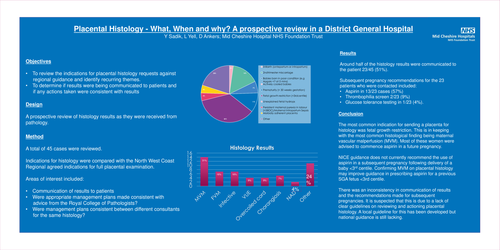
Around half of the histology results were communicated to the patient 23/45 (51%).
Subsequent pregnancy recommendations for the 23 patients who were contacted included:
Conclusion
The most common indication for sending a placenta for histology was fetal growth restriction. This is in keeping with the most common histological finding being maternal vascular malperfusion (MVM). Most of these women were advised to commence aspirin in a future pregnancy.
NICE guidance does not currently recommend the use of aspirin in a subsequent pregnancy following delivery of a baby <3rd centile. Confirming MVM on placental histology may improve guidance in prescribing aspirin for a previous SGA fetus <3rd centile.
There was an inconsistency in communication of results and the recommendations made for subsequent pregnancies. It is suspected that this is due to a lack of clear guidelines on reviewing and actioning placental histology. A local guideline for this has been developed but national guidance is still lacking.