1,830 posters, 67 videos, 75 audios, 29 topics, 22 sessions, 4,727 authors, 1,697 institutions
ePostersLive by SciGen Technologies S.A. All rights reserved.
RCOG World Congress 2023
June 12 - 14, 2023 | London, UK

EP.0602
Stratification of shoulder dystocia outcome according to manoeuvres, retrospective cohort and meta-analysis.
Poster Presenter
Authors
Nouran Elbarbary, Rohit Atre, Edward Golob, Dona Kurian, Radhika viswanatha, Vishali Ghai, Ramesh Ganapathy
Affiliations
Part of Topic
Labour Ward Management
Stratification of outcome of shoulder dystocia according to maneuver used for delivery, retrospective cohort and meta-analysis.
Objective: To explore correlation of neonatal injury in shoulder dystocia with the maneuver used, and time required for delivery, in trial to identify better ways of management of such complication.
Method: Retrospective cohort study, systematic review and meta-analysis of literature.
Results: In our local cohort of 157 cases (1.3% of total births), in analysis of duration of shoulder dystocia (head to body delivery interval, HBDI), there was no significant difference between cases that sustained mechanical injury (fractures, brachial plexus injury) and those without. While HBDI was significantly longer in cases with Ph < 7.1 (P=0.06).
There was no correlation between ph<7.1 and number of maneuvers used for delivery (Pearson’s correlation 0.04, P 0.6). The total number of mechanical injuries in our cohort was small to draw further conclusions.
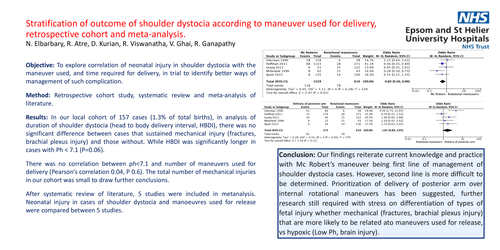
After systematic review of literature, 5 studies were included in metanalysis. Neonatal injury in cases of shoulder dystocia and manoeuvres used for release were compared between 5 studies.
Initial comparison performed between the reported injuries with the use of McRoberts vs rotational manoeuvres then McRoberts versus delivery of posterior arm. The risk of neonatal injury was significantly less with McRoberts in both situations, with OR 0.6 (95% CI 0.4-0.9) and 0.38 (95% CI 0.23-0.63) respectively.
On direct comparison between delivery of posterior arm vs rotational manoeuvres, there was no significant difference between both manoeuvres with regards to fetal injury. However, one should regard these results with caution due to significant heterogeneity in studies included with I2 = 57%.
Conclusion: Our findings reiterate current knowledge and practice with Mc Robert’s maneuver being first line of management of shoulder dystocia cases. However, second line is more difficult to be determined. Prioritization of delivery of posterior arm over internal rotational maneuvers has been suggested, further research still required with stress on differentiation of types of fetal injury whether mechanical (fractures, brachial plexus injury) that are more likely to be related to maneuvers used for release, vs hypoxic (Low Ph, brain injury).