1,830 posters, 67 videos, 75 audios, 29 topics, 22 sessions, 4,727 authors, 1,697 institutions
ePostersLive by SciGen Technologies S.A. All rights reserved.
RCOG World Congress 2023
June 12 - 14, 2023 | London, UK

EP.0598
Timing or Mistiming of Antenatal Corticosteroids
Poster Presenter
Authors
Affiliations
Part of Topic
Fetal Medicine
Timing or Mistiming of Antenatal Corticosteroids
While the benefits of antenatal corticosteroids are clear, there remains significant debate over the potential risks, particularly in terms of paediatric long term neurodevelopmental outcome.
The Royal College of Obstetricians & Gynaecologists (RCOG) published updated guidance on antenatal corticosteroid use in July 2022. They recommend corticosteroids should be administered to women between 24+0 and 34+6 weeks’ gestation at risk of imminent preterm delivery. They also recommend that women undergoing planned Caesarean section between 37+0 & 38+6 weeks’ gestation be fully counselled about the potential risk sand benefits about a course of antenatal corticosteroids.
A retrospective cohort study was performed on patients attending a single tertiary referral centre over an eight-month period to ascertain the timing of steroid administration prior to delivery, reason for steroid administration, and particularly to identify those who received steroids who subsequently delivered at term, and those who delivered preterm who did not receive steroids.
Hospital pharmacy records were analysed to obtain the number of patients who received at least one dose of either dexamethasone or betamethasone over the study period. This was correlated with electronic health records to ascertain gestational age at steroid administration, reason for administration, gestational age at delivery, time interval between steroid administration and delivery. Patients who received oral or intravenous steroids for other indications were excluded from analysis.
5435 patients delivered at our institution over the 8-month period from November 2021 to June 2022. 357 of these (6.6%) received at least one dose of antenatal corticosteroids. 100 patients (28%) delivered prior to 34 weeks’ gestation and 92% of these (92/100) received at least one dose of steroids.
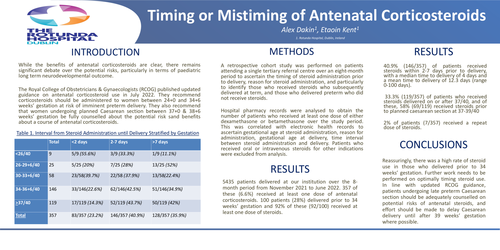
40.9% (146/357) of patients received steroids within 2-7 days prior to delivery, with a median time to delivery of 4 days and a mean time to delivery of 12.3 days (range 0-100 days).
33.3% (119/357) of patients who received steroids delivered on or after 37/40, and of these, 58% (69/119) received steroids prior to planned caesarean section at 37-39/40
2% of patients (7/357) received a repeat dose of steroids.
Reassuringly, there was a high rate of steroid use in those who delivered prior to 34 weeks’ gestation. Further work needs to be performed on optimally timing steroid use. In line with updated RCOG guidance, patients undergoing late preterm Caesarean section should be adequately counselled on potential risks of antenatal steroids, and effort should be made to delay Caesarean delivery until after 39 weeks’ gestation where possible.