1,830 posters, 67 videos, 75 audios, 29 topics, 22 sessions, 4,727 authors, 1,697 institutions
ePostersLive by SciGen Technologies S.A. All rights reserved.
RCOG World Congress 2023
June 12 - 14, 2023 | London, UK

EP.0590
Zika virus infection in pregnancy – An experience of outbreak in Kerala
Poster Presenter
Part of Topic
Pandemic and impact of Covid/Infectious Diseases
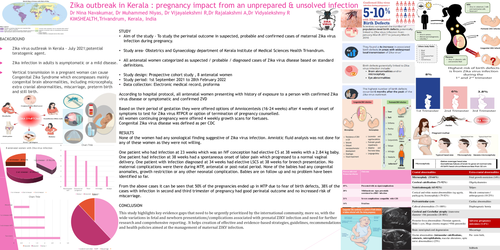
Title - Zika outbreak in Kerala : pregnancy impact from an unprepared & unsolved infection
BACKGROUND
STUDY
According to hospital protocol, all antenatal women presenting with history of exposure to a person with confirmed Zika virus disease or symptomatic and confirmed ZVD
Based on their period of gestation they were offered options of Amniocentesis (16-24 weeks) after 4 weeks of onset of symptoms to test for Zika virus RTPCR or option of termination of pregnancy counselled.
All women continuing pregnancy were offered 4 weekly growth scans for foetuses.
Congenital Zika virus disease was defined as per CDC
RESULTS
None of the women had any sonological finding suggestive of Zika virus infection. Amniotic fluid analysis was not done for any of these women as they were not willing.
One patient who had infection at 23 weeks which was an IVF conception had elective CS at 38 weeks with a 2.84 kg baby. One patient had infection at 38 weeks had a spontaneous onset of labor pain which progressed to a normal vaginal delivery. One patient with infection diagnosed at 34 weeks had elective LSCS at 38 weeks for breech presentation. No maternal complications were there during MTP, antenatal or post-natal period. None of the babies had any congenital anomalies, growth restriction or any other neonatal complication. Babies are on follow up and no problem have been identified so far.
From the above cases it can be seen that 50% of the pregnancies ended up in MTP due to fear of birth defects, 38% of the cases with infection in second and third trimester of pregnancy had good perinatal outcome and no increased risk of miscarriage.
CONCLUSION
This study highlights key evidence gaps that need to be urgently prioritized by the international community, more so, with the wide variations in fetal and newborn presentations/complications associated with prenatal ZIKV infection and need for further research and comprehensive reporting . It helps creation of effective and evidence-based strategies, guidelines, recommendations and health policies aimed at the management of maternal ZIKV infection.