1,830 posters, 67 videos, 75 audios, 29 topics, 22 sessions, 4,727 authors, 1,697 institutions
ePostersLive by SciGen Technologies S.A. All rights reserved.
RCOG World Congress 2023
June 12 - 14, 2023 | London, UK

EP.0588
Maternal Vascular Malperfusion: A near miss event?
Poster Presenter
Authors
Affiliations
Part of Topic
Hot Topics (Emerging research/issues) in Obstetrics
Maternal Vascular Malperfusion: A Near Miss Event?
Introduction
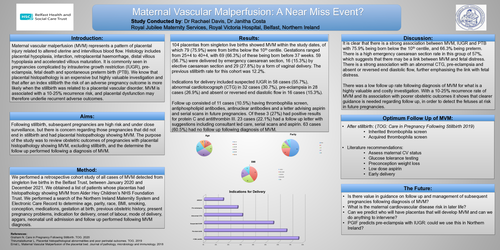
Maternal vascular malperfusion (MVM) represents a pattern of placental injury related to altered uterine and intervillous blood flow. Histology includes placental hypoplasia, infarction, retroplacental haemorrhage, distal villous hypoplasia and accelerated villous maturation. It is commonly seen in pregnancies complicated by intrauterine growth restriction (IUGR), pre-eclampsia, fetal death and spontaneous preterm birth (PTB). We know that placental histopathology is an expensive but highly valuable investigation and that after an index stillbirth the risk of an adverse pregnancy outcome is more likely when the stillbirth was related to a placental vascular disorder. MVM is associated with a 10-25% recurrence risk, and placental dysfunction may therefore underlie recurrent adverse outcomes.
Aims
Following stillbirth, subsequent pregnancies are high risk and under close surveillance, but there is concern regarding those pregnancies that did not end in stillbirth and had placental histopathology showing MVM. The purpose of the study was to review obstetric outcomes of pregnancies with placental histopathology showing MVM, excluding stillbirth, and the determine the follow up performed following a diagnosis of MVM.
Method
We performed a retrospective cohort study of all cases of MVM detected from singleton live births in the Belfast Trust, between January 2020 and December 2021. We obtained a list of patients whose placentas had histopathology showing MVM from Alder Hey Children’s NHS Foundation Trust. We performed a search of the Northern Ireland Maternity System and Electronic Care Record to determine age, parity, race, BMI, smoking, conception, medications, gestation at birth, previous obstetric history, present pregnancy problems, indication for delivery, onset of labour, mode of delivery, apgars, neonatal unit admission and follow up performed following MVM diagnosis.
Results
104 placentas from singleton live births showed MVM within the study dates, of which 79 (75.9%) were from births below the 10th centile. Gestations ranged from 25+4 to 40+4, with 69 (66.3%) of these being born before 37 weeks. 59 (56.7%) were delivered by emergency caesarean section, 16 (15.3%) by elective caesarean section and 29 (27.8%) by a form of vaginal delivery. The previous stillbirth rate for this cohort was 12.2%.
Indications for delivery included suspected IUGR in 58 cases (55.7%), abnormal cardiotocograph (CTG) in 32 cases (30.7%), pre-eclampsia in 28 cases (26.9%) and absent or reversed end diastolic flow in 16 cases (15.3%).
Follow up consisted of 11 cases (10.5%) having thrombophilia screen, antiphospholipid antibodies, antinuclear antibodies and a letter advising aspirin and serial scans in future pregnancies. Of these 3 (27%) had positive results for protein C and antithrombin III.23 cases (22.1%) had a follow up letter with suggestions including consultant led care, serial scans and aspirin. 63 cases (60.5%) had no follow up following diagnosis of MVM.
Discussion
It is clear that there is a strong association between MVM, IUGR and PTB with 75.9% being born below the 10th centile, and 66.3% being preterm. There is a high emergency caesarean section rate in this group of 57%, which suggests that there may be a link between MVM and fetal distress. There is a strong association with an abnormal CTG, pre-eclampsia and absent or reversed end diastolic flow, further emphasising the link with fetal distress.
There was a low follow up rate following diagnosis of MVM for what is a highly valuable and costly investigation. With a 10-25% recurrence rate of MVM and its association with poorer obstetric outcomes it shows that clearer guidance is needed regarding follow up, in order to detect the fetuses at risk in future pregnancies.
Optimum Care Following Stiilbirth
•Literature recommendations:
The Future