1,830 posters, 67 videos, 75 audios, 29 topics, 22 sessions, 4,727 authors, 1,697 institutions
ePostersLive by SciGen Technologies S.A. All rights reserved.
RCOG World Congress 2023
June 12 - 14, 2023 | London, UK

EP.0571
Predicting Maternal Morbidity using the Obstetric Comorbidity Index Tool & Simple Risk Classification
Poster Presenter
Authors
Affiliations
Part of Topic
High Risk Pregnancy
Audio
Predicting Maternal Morbidity using the Obstetric Comorbidity Index Tool & Simple Risk Classification
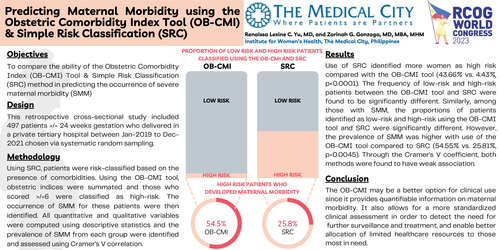
Objective: To compare the ability of the Obstetric Comorbidity Index (OB-CMI) Tool & Simple Risk Classification (SRC) method in predicting the occurrence of severe maternal morbidity (SMM)
Design
This retrospective cross-sectional study included 497 patients >/= 24 weeks gestation who delivered in a private tertiary hospital between Jan-2019 to Dec-2021 chosen via systematic random sampling.
Method
Using SRC, patients were risk-classified based on the presence of comorbidities. Using the OB-CMI tool, obstetric indices were summated and those who scored >/=6 were classified as high-risk. The occurrence of SMM for these patients were then identified. All quantitative and qualitative variables were computed using descriptive statistics and the prevalence of SMM from each group were identified and assessed using Cramer’s V correlation.
Results: Use of SRC identified more women as high risk compared with the OB-CMI tool. The frequency of low-risk and high-risk patients between the OB-CMI tool and SRC were found to be significantly different. Similarly, among those with SMM, the proportions of patients identified as low-risk and high-risk using the OB-CMI tool and SRC were significantly different. However, the prevalence of SMM was higher with use of the OB-CMI tool compared to SRC. Through the Cramer’s V coefficient, both methods were found to have weak association.
Conclusion: The OB-CMI may be a better option for clinical use since it provides quantifiable information on maternal morbidity. It also allows for a more standardized clinical assessment in order to detect the need for further surveillance and treatment, and enable better allocation of limited healthcare resources to those most in need.