1,830 posters, 67 videos, 75 audios, 29 topics, 22 sessions, 4,727 authors, 1,697 institutions
ePostersLive by SciGen Technologies S.A. All rights reserved.
RCOG World Congress 2023
June 12 - 14, 2023 | London, UK

EP.0566
Characteristics and survival outcome of Ovarian Clear cell carcinoma OCCC: Oxford experience
Part of Topic
Gynae Oncology
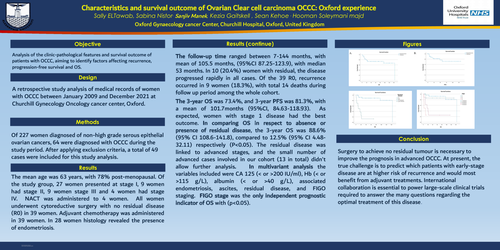
Objective: Analysis of the clinic-pathological features and survival outcome of patients with OCCC, aiming to identify factors affecting recurrence, progression-free survival and OS.
Design: A retrospective study analysis of medical records of women with OCCC between January 2009 and December 2021 at Churchill Gynecology Oncology cancer center, Oxford.
Methods: Of 227 women diagnosed of non-high grade serous epithelial ovarian cancers, 64 were diagnosed with OCCC during the study period. After applying exclusion criteria, a total of 49 cases were included for this study analysis.
Results: The mean age was 63 years, with 78% post-menopausal. Of the study group, 27 women presented at stage I, 9 women had stage II, 9 women stage III and 4 women had stage IV. NACT was administered to 4 women. All women underwent cytoreductive surgery with no residual disease (R0) in 39 women. Adjuvant chemotherapy was administered in 39 women. In 28 women histology revealed the presence of endometriosis.
The follow-up time ranged between 7-144 months, with mean of 105.5 months, (95%CI 87.25-123.9), with median 53 months. In 10 women with residual, the disease progressed rapidly in all cases. Of the 39 R0, recurrence occurred in 9 women (18.3%), with total 14 deaths during follow up period among the whole cohort.
The 3-year OS was 73.4%, and 3-year PFS was 81.3%, with a mean of 101.7months (95%CI, 84.63-118.93). As expected, women with stage 1 disease had the best outcome. In comparing OS in respect to absence or presence of residual disease, the 3-year OS was 88.6% (95% CI 108.6-141.8), compared to 12.5% (95% CI 4.48-32.11) respectively (P<0.05). The residual disease was linked to advanced stages, and the small number of advanced cases involved in our cohort (13 in total) didn’t allow further analysis. In multivariant analysis the variables included were CA 125 (< or >200 IU/ml), Hb (< or >115 g/L), albumin (< or >40 g/L), associated endometriosis, ascites, residual disease, and FIGO staging. FIGO stage was the only independent prognostic indicator of OS with (p<0.05).
Conclusion: Surgery to achieve no residual tumour is necessary to improve the prognosis in advanced OCCC. At present, the true challenge is to predict which patients with early-stage disease are at higher risk of recurrence and would most benefit from adjuvant treatments. International collaboration is essential to power large-scale clinical trials required to answer the many questions regarding the optimal treatment of this disease.