1,830 posters, 67 videos, 75 audios, 29 topics, 22 sessions, 4,727 authors, 1,697 institutions
ePostersLive by SciGen Technologies S.A. All rights reserved.
RCOG World Congress 2023
June 12 - 14, 2023 | London, UK

EP.0563
An Evidence Synthesis of Pharmaceutical Interventions used in Chronic Pain Management (WP1a)
Poster Presenter
Authors
Ashish Shetty, Gayathri Delanerolle, Heitor Cavalini, Chunli Deng, Arun Bhaskar, Yutian Zheng, Peter Phiri, Sohier Elneil, Jian Shi
Affiliations
University of Oxford, University College London, Imperial College Healthcare NHS Trust, University College London Hospitals NHS Foundation Trust, Southern Health NHS Foundation Trust, Southern University of Science and Technology
Part of Topic
Hot Topics (Emerging research/issues) in Gynaecology
INTRODUCTION
Chronic non-cancer pain conditions are highly prevalent, impacting 20% of the global population. Complexities around diagnosis and treatment of chronic pain conditions have meant that there is a paucity of standardised clinical guidelines that could potentially improve the clinical practice landscape, globally (1,2.)The prevalence of pain conditions among females of all ages appears to increase more rapidly in comparison to other genders. Increase in chronic pain conditions contribute to higher healthcare costs and economic burden.
Increase in addiction and opioid use is another challenge among non-cancer chronic pain patients. Current clinical guidelines recommend non-invasive pain management options as a first-line treatment among non-cancer patients in particular, although overdose, dependency and mortality due to opioid use has consistently increased over time. It was reported that global opioid use has doubled between 2001 and 2003 to 2011 and 2013 to 7·35 billion daily doses per year. As such, there is an increasing need to better understand comparative effectiveness of interventions and to develop optimal evidence- based-practices to support future populations of patients.
We designed the Prevalence of Pain (POP) project as an initial step to explore non-cancer chronic pain management globally. In this abstract, we report 2 important findings on pharmaceutical pain management.
Objective
The aim was to report the prevalence and efficacy of pharmaceutical management among non-cancer chronic pain patients.
Study design
We designed a multi-workstream pain management project with a view to develop a data- connectivity study. This abstract reflects the first of a five-part evidence synthesis.
METHOD
We published the developed systematic methodology in PROSPERO(CRD42021235384). Allpeerreviewedandpublished randomised clinical trials, mixed methods and epidemiology studies from the 1st of January 1990 -30th April 2022 were used. We devised a meta-analysis and a network meta-analysis to compare the effectiveness of a range of pharmaceutical drugs. To assess the summary of effect sizes, a meta-analysis of mean differences between drugs and placebos were applied and reported using mean differences with a 95% confidence interval. The full analyses was conducted by R.
RESULTS
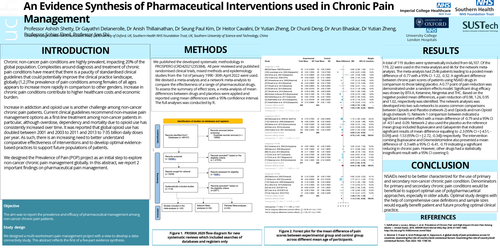
A total of 119 studies were systematically included from 66,107. Of the 119, 22 were used in the meta-analysis and 46 for the network meta- analysis. The meta-analysis had 2546 patients leading to a pooled mean difference of -0.77 with a 95% CI -1.22, -0.32. A significant difference between chronic pain scores of patients using NSAID drugs in comparison to those taking placebo. A 0.77 point of pain reduction was demonstrated under a random effects model. Significant drug efficacy was shown by BTX-A, Ketamine, Ningmitai and THC. Based on the negative pooled mean differences, a pain reduction of 0.98, 1.26, 0.95 and 1.02, respectively was identified. The network analyses was developed into two sub-networks to assess common comparisons between Opioids and Placebo (network-2) and Opioids and non-Opioid drugs (network-1). Network-1 comparison between indicated a significant treatment effect with a mean difference of -0.79 and a 95% CI of -4.51 and -0.09. Network-2 also used the placebo as the reference mean group included Bupivacaine and Gabapentin that indicated significant results of mean difference equalling to -2.3 (95% CI = [-4.51, - 0.09]) and -1.53 (95% CI = [-2.72, -0.34]) respectively. The intervention combing Bupivacaine and Dexmedetomidine also presented a mean difference of -3.3 with a 95% CI -6.41, -0.19 indicating a significant reducing in chronic pain. However, other drugs had a statistically insignificant result with a 95% CI covering 0.
CONCLUSION
NSAIDs need to be better characterized for the use of primary and secondary non-cancer chronic pain condition. Denominators for primary and secondary chronic pain conditions would be beneficial to support optimal use of polypharmacuetical approaches, especially in older adults. Optimal study designs with the help of comprehensive case definitions and sample sizes would equally benefit patient and future proofing optimal clinical practice.
Reference
1. Dahlhamer J, Lucas J, Zelaya, C, et al. Prevalence of Chronic Pain and High-Impact Chronic Pain Among Adults — United States, 2016. MMWR Morb Mortal Wkly Rep 2018; 67:1001–1006. http://dx.doi.org/10.15585/mmwr.mm6736a2
2. Zimmer Z, Fraser K, Grol-Prokopczyk H, Zajacova A. A global study of pain prevalence across 52 countries: examining the role of country-level contextual factors: Examining the role of country-level contextual factors. Pain 2022; 163: 1740–50.