1,830 posters, 67 videos, 75 audios, 29 topics, 22 sessions, 4,727 authors, 1,697 institutions
ePostersLive by SciGen Technologies S.A. All rights reserved.
RCOG World Congress 2023
June 12 - 14, 2023 | London, UK

EP.0562
Exploratory Systematic Review and Meta-analysis on Period Poverty
Poster Presenter
Authors
Gayathri Delanerolle, Xiaojie Yang, Heitor Cavalini, Om Kurmi, Camilla Rostivik, Ashish Shetty, Lucky Saraswat, Julie Taylor, Sana Said, Shanaya Rathod, Jian Shi, Peter Phiri
Affiliations
University of Birmingham, University of Aberdeen, Southern Health NHS Foundation Trust, Southern University of Science and Technology, University of Coventry, St Andrews University, University of College Hospitals NHS Foundation
Part of Topic
Hot Topics (Emerging research/issues) in Gynaecology
INTRODUCTION
The World Health Organisation (WHO) defines health as complete mental, physical, and social well-being and not merely the absence of disease or illness. Menstrual health is integral to women's overall health, as menstruation can significantly impact mental, physical, and social well-being. Menstruation is a biological process experienced by nearly every biological female and is defined as cyclical bleeding due to the regeneration of the uterine endometrium corpus. However, not all women experience normal menstrual bleeding, with approximately 30% experiencing alterations to their pattern or volume of menstrual flow due to multiple aetiologies(1). Many women report symptoms such as pain, anxiety, fatigue, dysmenorrhea, and depression associated with their menstrual cycle, potentially requiring clinical involvement to diagnose potential reproductive health issues such as premenstrual dysphoric disorder, premenstrual syndrome, or endometriosis (1).
Access to menstrual products is vital, as the WHO and UNICEF have reported that many girls miss school and stay home during menstruation due to reasons including access to toilets or menstrual products (2). This is commonly reported as period or menstruation poverty (3). Period poverty is a global health issue impacting those without access to hygienic and safe menstrual products. This is particularly important in regions with conflicts and disasters, which leave menstruating individuals with minimal or no access to safe products or clean toilets, leading to unconventional methods of managing bleeding.
Period poverty is associated with stigma, shame, and overall well-being. In the UK, over 37% of women have experienced period shaming (4). Period poverty appears to be a global phenomenon, and key sociological and clinical features may differ due to varying risk factors in diverse geographical regions. To identify the impact of period poverty in diverse populations and common denominators observed between low-middle-income countries (LMICs) and high-income countries, it is vital to better understand current gaps in knowledge, policies and practice.
ObjectiveS
To identify the impact of period poverty in diverse populations and common denominators observed between low-middle-income countries (LMICs) and high-income countries
Study design
A systematic methodology was developed and published on PROSPERO (CRD42022339536)
METHOD
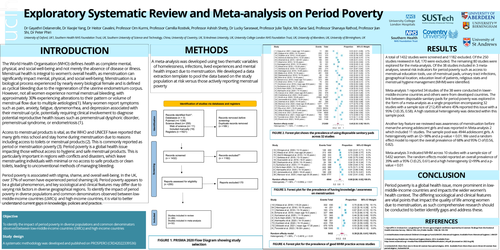
A meta-analysis was developed using two thematic variables of homelessness, infections, lived experiences and mental health impact due to menstruation. We developed a data extraction template to pool the data based on the study population at risk versus those actively reporting menstrual poverty
RESULTS
A total of 1432 studies were screened and 1182 excluded. Of the 250 studies reviewed in full, 170 were excluded. The remaining 80 studies were explored for the meta-analysis. Of the 38 studies included in 3 meta-analyses, several risk indicators for period poverty such as access to menstrual education tools, use of menstrual pads, urinary tract infections, geographical location, education level of patients, religious stats and menstrual hygiene management (MHM) were identified.
Meta-analysis 1 reported 34 studies of the 38 were conducted in lower-middle-income countries and others were from developed countries. The link between disposable sanitary pads for period poverty was explored in the form of a meta-analysis as a single proportion encompassing 32 studies with a sample size of 212,459 where 45% reported this issue with a 95% CI (0.35, 0.58). A high statistical heterogeneity was detected within this sample pool.
Another key feature we reviewed was awareness of menstruation before menarche among adolescent girls and was reported in Meta-analysis 2 which included 11 studies. The sample pool was 4944 adolescent girls. A heterogeneity with an I2= 98% and a p-value < 0.01. We used a random effect model to report the overall prevalence of 68% and 95% CI of (0.56, 0.82).
Meta-analysis 3 indicated MHM across 10 studies with a sample size of 5432 women. The random effects model reported an overall prevalence of 39% with a 95% CI (0.25, 0.61) and a high heterogeneity I2=99% and a p-value < 0.01
CONCLUSION
Period poverty is a global health issue, more prominent in address these. low-middle-income countries and impacts the wider women's health context. The differing sociological and clinical features are vital points that impact the quality of life among women due to menstruation. Conducting comprehensive research with using diverse populations should be regarded as a priority by clinicians and clinical researchers.