1,830 posters, 67 videos, 75 audios, 29 topics, 22 sessions, 4,727 authors, 1,697 institutions
ePostersLive by SciGen Technologies S.A. All rights reserved.
RCOG World Congress 2023
June 12 - 14, 2023 | London, UK

EP.0561
Ovarian Torsion- Are ovaries slavageable after torsion?
Poster Presenter
Part of Topic
Benign Gynaecology
Introduction:
Ovarian torsion occurs when ovary twists over the ligament that support adnexa i.e. suspensory ligament of ovaries(attaches ovaries to pelvic side walls) and utero ovarian ligament.
The fallopian tube often twists with the ovary and is then referred to as adnexal torsion.
Ovary has a dual blood supply from ovarian arteries and uterine arteries. Twisting of Ligaments can lead to the venous congestion, edema, compression of arteries and eventually loss of blood supply of ovary leading to necrosis, peritonitis, loss of ovary and infertility if not identified properly.
Overall incidence of ovarian torsion is 2% to 15%
Main risk factors for ovarian torsion are adnexal mass>5cm, long ovarian ligaments, PCOS, and infertility treatment.
Objective:
Main objective is to study the outcome of ovarian conservation in ovarian/ adenexal torsion in women of age group 20 40 yrs
Methods:
Retrospective case review was conducted for women with suspicion of ovarian torsion and later confirmed on laparoscopy, over 2 different tertiary care hospitals in South Punjab
The duration of study was 2 years, from Feb 2020 to Feb 2022. Inclusion criteria also included age group 20 40 yrs , presence of pre op pain lower abdomen, nausea, vomiting and reduced blood flow on Doppler studies. Sample size was 20.
Results:
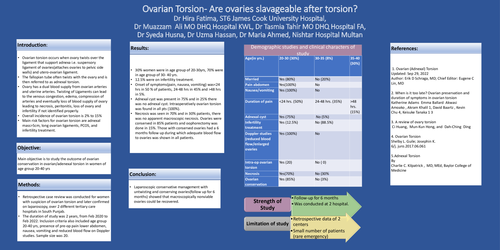
30% women were in age group of 20 30yrs, 70% were in age group of 30 40 yrs.
12.5% were on infertility treatment.
Onset of symptoms(pain, nausea, vomiting) was<24 hrs in 50 % of patients, 24 48 hrs in 45% and >48 hrs in 5%.
Adnexal cyst was present in 75% and in 25% there was no adnexal cyst. Intraoperatively ovarian torsion was found in all pts (100%).
Necrosis was seen in 70% and in 30% patients, there was no apparent macroscopic necrosis. Ovaries were conserved in 85% patients and oophorectomy was done in 15%. Those with conserved ovaries had a 6 months follow up during which adequate blood flow to ovaries was shown in all patients.
Conclusion:
Laparoscopic conservative management with untwisting and conserving ovaries(follow up for 6 months) showed that macroscopically nonviable ovaries could be recovered.
References:
1. Ovarian (Adnexal) Torsion
Updated: Sep 29, 2022
Author: Erik D
Schraga , MD; Chief Editor: Eugene C
Lin, MD
2. When is it too late? Ovarian preservation and
duration of symptoms in ovarian torsion
Katherine Adams
Emma Ballard Akwasi
Amoako Akram Khalil 1, David Baartz Kevin
Chu 4, Keisuke Tanaka 1 3
3. A review of ovary torsion
Ci Huang,
Mun Kun Hong, and Dah Ching Ding
4. Ovarian Torsion
Shelby L. Guile;
Josephin K.
6/j. juro.2017.06.061
5.Adnexal Torsion
By
Charlie C. Kilpatrick, MD, MEd, Baylor College of
Medicine