1,830 posters, 67 videos, 75 audios, 29 topics, 22 sessions, 4,727 authors, 1,697 institutions
ePostersLive by SciGen Technologies S.A. All rights reserved.
RCOG World Congress 2023
June 12 - 14, 2023 | London, UK

EP.0560
Cervical Cerclage Audit Performed at Queen's Hospital Romford
Poster Presenter
Authors
Affiliations
Part of Topic
High Risk Pregnancy
INTRODUCTION
Preterm birth is a common complication of pregnancy effecting up to 8% of pregnancies. It is the single most important determinant of adverse fetal outcomes according to Saving Babies Lives version 2. NICE guidelines for preterm labour recommend that any woman with a history of preterm labour <34+0 or late miscarriage >16+0 + cervical length USS less 25mm between 16+0 and 24+0 should be offered the choice of vaginal progesterone or cervical cerclage.
OBJECTIVES
We aimed to review all cervical cerclages performed at Queen’s Hospital. Our goal was to assess the type of cerclages performed, the effectiveness of this intervention (number of pregnancies carried to term), complication rates and review whether the indications for these procedures complied with NICE guidance.
METHODS
Retrospective audit of all cerclages performed at Queen’s Hospital over an 18 month period. All cervical cerclages performed between January 2021 - July 2022 were included. We reviewed paper notes and intrapartum electronic notes from the K2 Athena system. We assessed suture technique Shirodkar vs MacDonald, suture material used, outcomes and complications following cerlcage insertion, whether indication for insertion met NICE guidance and if antibiotic and progesterone were given post insertion.
RESULTS
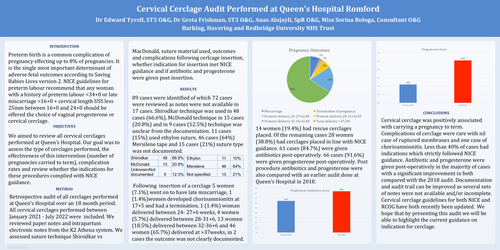
89 cases were identified of which 72 cases were reviewed as notes were not available in 17 cases. Shirodkar technique was used in 48 cases (66.6%), McDonald technique in 15 cases (20.8%) and in 9 cases (12.5%) technique was unclear from the documentation. 11 cases (15%) used ethylon suture, 46 cases (64%) Mersilene tape and 15 cases (21%) suture type was not documented. Following insertion of a cerclage 5 women (7.1%) went on to have late miscarriage, 1 (1.4%)women developed chorioamnionitis at 17+5 and had a termination, 1 (1.4%) woman delivered between 24- 27+6 weeks, 4 women (5.7%) delivered between 28-31+6, 13 women (18.5%) delivered between 32-36+6 and 46 women (65.7%) delivered at >37weeks, in 2 cases the outcome was not clearly documented. 14 women (19.4%) had rescue cerclages placed. Of the remaining cases 28 women (38.8%) had cerclages placed in line with NICE guidance. 61 cases (84.7%) were given antibiotics post-operatively. 66 cases (91.6%) were given progesterone post-operatively. Post procedure antibiotics and progesterone were also compared with an earlier audit done at Queen’s Hospital in 2018.
CONCLUSIONS
Cervical cerclage was positively associated with carrying a pregnancy to term. Complications of cerclage were rare with nil case of ruptured membranes and one case of chorioamnionitis. Less than 40% of cases had indications which strictly followed NICE guidance. Antibiotic and progesterone were given post-operatively in the majority of cases with a significant improvement in both compared with the 2018 audit. Documentation and audit trail can be improved as several sets of notes were not available and/or incomplete. Cervical cerclage guidelines for both NICE and RCOG have both recently been updated. We hope that by presenting this audit we will be able to highlight the current guidance on indication for cerclage.