1,830 posters, 67 videos, 75 audios, 29 topics, 22 sessions, 4,727 authors, 1,697 institutions
ePostersLive by SciGen Technologies S.A. All rights reserved.
RCOG World Congress 2023
June 12 - 14, 2023 | London, UK

EP.0556
VBAC – An Indian perspective
Poster Presenter
Authors
Affiliations
Part of Topic
High Risk Pregnancy
VBAC – An Indian perspective
Chandrakala Magudapathi, Vishnuprabha Soundarrajan
Genesis Royal Infirmary, Coimbatore, India
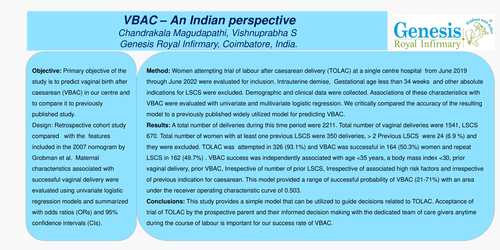
Objective: Primary objective of the study is to predict vaginal birth after cesarean section (VBAC) in our centre and to compare it to previously published study.
Design: Retroscpective cohort study compared with the the features included in the 2007 nomogram by Grobman et al. Maternal characteristics associated with successful vaginal delivery were evaluated using univariate logistic regression models and summarized with odds ratios (ORs) and 95% confidence intervals (CIs).
Method:Women attempting trial of labor after cesarean delivery (TOLAC) at a single centre hospital from June 2019 through June 2022 were evaluated for inclusion. Intrauterine demise, Gestational age less than 34 weeks and other absolute indications for LSCS were excluded. Demographic and clinical data were collected.Associations of these characteristics with VBAC were evaluated with univariate and multivariate logistic regression. We critically compared the accuracy of the resulting model to a previously published widely utilized model for predicting VBAC.
Results: A total number of deliveries during this time period were 2211. Total number of vaginal deliveries were 1541, LSCS 670. Total number of women with atleast one previous LSCS were 350 deliveries, > 2 Previous LSCS were 24 (6.9 %) and they were excluded. TOLAC was attempted in 326 (93.1%) and VBAC was sucessful in 164 (50.3%) women and repeat LSCS in 162 (49.7%) . VBAC success was independently associated with age <35 years, a body mass index <30, prior vaginal delivery, prior VBAC, Irrespective of number of prior LSCS, Irrespective of associated high risk factors and irrespective of previuos indication for cesarean. This model provided a range of successful probability of VBAC (21-71%) with an area under the receiver operating characteristic curve of 0.503.
Conclusions:This study provides a simple model that can be utilized to guide decisions related to TOLAC.Acceptance of trial of TOLAC by the prospective parent and their informed decision making with the dedicated team of care givers anytime during the course of labour is important for our sucess rate of VBAC.