1,830 posters, 67 videos, 75 audios, 29 topics, 22 sessions, 4,727 authors, 1,697 institutions
ePostersLive by SciGen Technologies S.A. All rights reserved.
RCOG World Congress 2023
June 12 - 14, 2023 | London, UK

EP.0550
Outcomes of caesarean section delivery in women with BMI > 50
Poster Presenter
Authors
Affiliations
Part of Topic
Obesity
Outcomes of caesarean section delivery in women with BMI > 50
Objective:
Obesity is becoming increasingly prevalent in the UK and is one of the most common risk factors in obstetric practice, with 21.3% of the antenatal population being obese1
Pregnant women who are obese are at greater risk of various pregnancy-related complications2. High pre-pregnancy BMI is associated with a small but statistically significant increase in severe maternal morbidity or mortality3
The standards taken from RCOG, ‘’care of women with obesity in pregnancy’’, and NICE ‘’caesarean section guidelines’’.
The objective of the audit was to determine the outcome after a caesarean section (CS) in obese women and to compare results with the standards.
To identify areas of improvement to reduce the risk of infection and to minimise re-admission.
Design:
A retrospect review of all patients with BMI > 50 who were delivered by CS between Jan 2018 to Dec 2020 at NHS Greater Glasgow and Clyde
Method:
All births over the period were identified using the electronic maternity system, Badgernet. All pregnant women with BMI > 50 included, delivered by CS and excluded all patients with BMI < 50
Results:
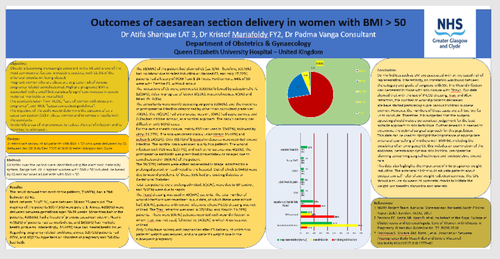
The result showed that most of the patients, 71(93%), had a BMI between 50-60.
Most patients, 54 (71%), were between 26 and 35 years old.
Majority of the patients 59(77.5%) were para 0-1
Almost 68(89%) were delivered between gestational ages 36-39 weeks
than half of the patients, 42(55.2%), had a history of previous caesarean section.
More Nearly 47(62%) of patients had co-morbidities, and 16(34.7%) had multiple health problems. Interestingly 34(44%) have had mental health issues. Regarding pregnancy related problems, almost 32(71%) patients had GDM, and 10(22%) hypertension disorders of pregnancy and 3(6.6%) had both.
51(66%) of the patient had planned CS (cat 3/4). Therefore, 59(77.6%) had no labour due to failed induction or planned CS, and only 17(22%) patients had a history of ROM from 1-24 hours. Furthermore, 64% of SSI were with Elective CS, without labour.
indications of CS were, previous CS 30(39%) followed by suboptimal CTG 12(15.7%), delay in progress of labour 8(10.5%), maternal request 6(7.8%) and failed IOL 6(7.8%)
The consultants were mainly operating surgeons 52(68%), and the incidence of postoperative infection categorised by other than consultant grade was 7(41%). The 70(92%) had a transverse incision, 3(3.9%) had supra pannus, and 2(2.6%) had midline incision, as a surgical approach. The
The baby's delivery was difficult in only 6(3%) cases.
For the rectus sheath closure, mainly PDS was used in 50(65%), followed by vicryl 21(27%). After that, the skin was closed mainly using biosyn 34(44%) and polysorb 24(31.5%). Only 3(17%) of biosyn skin closures were reported wound infection. The surgical drain was used in only two patients.
The wound infection with PDS was 11(77%), and with other sutures was 4(23%).
The postoperative antibiotic was prescribed (immediately or delayed due to complications) in 36(47%) of the patient.
38(50%) patients were either represented in triage, admitted for a prolonged period, or readmitted to the hospital. Out of which 17(44%) were due to wound problems. Of these, 35% had pre-existing diabetes or Gestational Diabetes.
Regarding prolonged admission, a total of ten patients, 5(50%), were due to BP control, and 3(30%) were due to sepsis. However, interestingly, only one patient was returned to the theatre as the drain removal was done under anaesthesia.
Only 3(4%) have subsequent pregnancies after CS delivery, of which two patients' weight was reduced, and one patient's weight rose in the subsequent pregnancy.
The Picod dressing was used in 49(64%) patients. However, the total number of wound infections was 17 in our data, of which there were almost half, 8 (47%), patients with wound infections where PICOD dressing was not utilised.
The Traxi retractor was used in 37(48%), and Alexi in 21(27.6%) patients.
There were 8(47%) patients reported with wound infection in whom Traxi was not used, followed by 14(82%) in which Alexi was not utilised.
Conclusion:
Co-morbidities such as DM are associated with an increased risk of representation. Interestingly, no correlation was found between the category and grade of surgeons with SSI Wound infection was decreased in those with skin closure with braided sutures (Biosyn). Our data showed that with the use of PICOD dressing, Traxi and Alexi retractors, the number of wound problems decreased.
We have started performing supra pannus incisions in obese women. However, the numbers of these cases are still too low for us to conclude. Therefore, it is suggested that the surgeon operating should make a personalised judgement for the best suitable approach to skin technique. Further research is needed to determine the optimal surgical approach for this population.
This data can be used within our department to highlight the importance of appropriate antenatal counselling of mothers with BMI>50, including the possibility of an emergency CS; this includes an examination of the abdomen, determining optimal skin incision, pre-operative planning concerning surgical technique and postoperative wound care.
This data also highlights the importance of interpregnancy weight reduction. The antenatal clinic should educate patients about postpartum self-referral and weight reduction services. The GPs should also use six weeks of post-natal checks to initiate the weight loss benefits discussion and referrals.
References:
- NMPA Project Team. National Maternal and Perinatal Audit: Clinical Report 2017. London: RCOG; 2017
- Denison FC, Aedla NR, Keag O, Hor K, Reynolds RM, Milne A, Diamond A, on behalf of the Royal College of Obstetricians and Gynaecologists. Care of Women with Obesity in Pregnancy. Green-top Guideline No. 72. BJOG 2018
- Lisonkova S, Muraca GM, Potts J, Liauw J, Chan WS, Skoll A, et al. Association Between Prepregnancy Body Mass Index and Severe Maternal Morbidity.JAMA2017;318:1777–86