1,830 posters, 67 videos, 75 audios, 29 topics, 22 sessions, 4,727 authors, 1,697 institutions
ePostersLive by SciGen Technologies S.A. All rights reserved.
RCOG World Congress 2023
June 12 - 14, 2023 | London, UK

EP.0127
Antenatal, intrapartum and postnatal care of obese patients: a retrospective single-centre study
Poster Presenter
Authors
Affiliations
Part of Topic
Obesity
Antenatal, intrapartum and postnatal care of obese patients: a retrospective single-centre study]
Mohamed Ragab1, Sophie Bracke1, Reena Kotecha1
1 Whipps Cross Hospital, London
Introduction
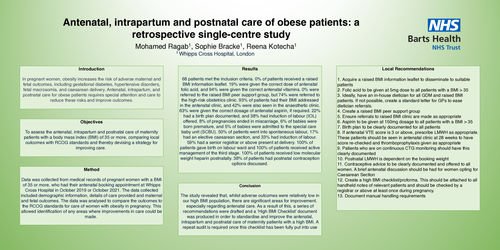
In pregnant women, obesity increases the risk of adverse maternal and fetal outcomes, including gestational diabetes, hypertensive disorders, fetal macrosomia, and caesarean delivery. Antenatal, intrapartum, and postnatal care for obese patients requires special attention and care to reduce these risks and improve outcomes.
Objectives
To assess the antenatal, intrapartum and postnatal care of maternity patients with a body mass index (BMI) of 35 or more, comparing local outcomes with RCOG standards and thereby devising a strategy for improving care.
Method
Data was collected from medical records of pregnant women with a BMI of 35 or more, who had their antenatal booking appointment at Whipps Cross Hospital in October 2019 or October 2021. The data collected included demographic information, details of care provided and maternal and fetal outcomes. The data was analysed to compare the outcomes to the RCOG standards for care of women with obesity in pregnancy. This allowed identification of any areas where improvements in care could be made.
Results
68 patients met the inclusion criteria. 0% of patients received a raised BMI information leaflet. 19% were given the correct dose of antenatal folic acid, and 94% were given the correct antenatal vitamins. 0% were referred to the raised BMI peer support group, but 74% were referred to the high-risk obstetrics clinic. 93% of patients had their BMI addressed in the antenatal clinic, and 42% were also seen in the anaesthetic clinic. 63% were given the correct dosage of antenatal aspirin, if required. 22% had a birth plan documented, and 38% had induction of labour (IOL) offered. 8% of pregnancies ended in miscarriage, 6% of babies were born premature, and 5% of babies were admitted to the special care baby unit (SCBU). 50% of patients went into spontaneous labour, 17% had an elective caesarean section, and 33% had induction of labour. 59% had a senior registrar or above present at delivery. 100% of patients gave birth on labour ward and 100% of patients received active management of the third stage. 100% of patients received low molecular weight heparin postnatally. 38% of patients had postnatal contraception options discussed.
Conclusion
The study revealed that, whilst adverse outcomes were relatively low in our high BMI population, there are significant areas for improvement, especially regarding antenatal care. As a result of this, a series of recommendations were drafted and a ‘High BMI Checklist’ document was produced in order to standardise and improve the antenatal, intrapartum and postnatal care of maternity patients with a high BMI. A repeat audit is required once this checklist has been fully put into use
Local Recommendations
9. Patients who are on continuous CTG monitoring should have this clearly documented
10. Postnatal LMWH is dependent on the booking weight
11. Contraceptive advice to be clearly documented and offered to all women. A brief antenatal discussion should be had for women opting for Caesarean Section