1,830 posters, 67 videos, 75 audios, 29 topics, 22 sessions, 4,727 authors, 1,697 institutions
ePostersLive by SciGen Technologies S.A. All rights reserved.
RCOG World Congress 2023
June 12 - 14, 2023 | London, UK

EP.0541
Reduced fetal movements under 28 weeks: risk factors, outcomes, and care implications.
Poster Presenter
Authors
Clare Shakespeare, Emma Griffiths, Sneha Basude, Rachna Bahl
Affiliations
Part of Topic
Hot Topics (Emerging research/issues) in Obstetrics
EP 0541: Reduced fetal movements under 28 weeks: risk factors, outcomes, and care implications
C Shakespeare, E Griffiths, S Basude, R Bahl. St Michaels Hospital, UHBW, Bristol, United Kingdom.
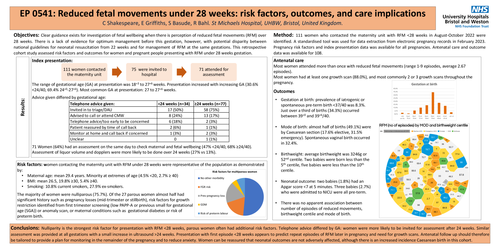
Objectives: Clear guidance exists for investigation of fetal wellbeing when there is perception of reduced fetal movements (RFM) over 28 weeks. There is a lack of evidence for optimum management before this gestation, however, with potential disparity between national guidelines for neonatal resuscitation from 22 weeks and for management of RFM at the same gestations. This retrospective cohort study assessed risk factors and outcomes for women and pregnant people presenting with RFM under 28 weeks gestation.
Method: 111 women who contacted the maternity unit with RFM <28 weeks in August-October 2022 were identified. A standardised tool was used for data extraction from electronic pregnancy records in February 2023. Pregnancy risk factors and index presentation data was available for all pregnancies. Antenatal care and outcome data was available for 108.
Index presentation: The range of gestational age (GA) at presentation was 18+3 to 27+6 weeks. Presentation increased with increasing GA (30.6% <24/40, 69.4% 24+0-27+6). Most common GA at presentation: 27 to 27+6 weeks.
Advice given differed by gestational age:
71 Women (64%) had an assessment on the same day to check maternal and fetal wellbeing (47% <24/40, 68% ≥24/40). Assessment of liquor volume and dopplers were more likely to be done over 24 weeks (27% vs 13%).
Risk factors: women contacting the maternity unit with RFM under 28 weeks were representative of the population as demonstrated by:
The majority of women were nulliparous (75.7%). Of the 27 parous women almost half had significant history such as pregnancy losses (mid-trimester or stillbirth), risk factors for growth restriction identified from first trimester screening (low PAPP-A or previous small for gestational age (SGA)) or anomaly scan, or maternal conditions such as gestational diabetes or risk of preterm birth.
Antenatal care: Most women attended more than once with reduced fetal movements (range 1-9 episodes, average 2.67 episodes). Most women had at least one growth scan (88.0%), and most commonly 2 or 3 growth scans throughout the pregnancy.
Outcomes:
Conclusions: Nulliparity is the strongest risk factor for presentation with RFM <28 weeks, parous women often had additional risk factors. Telephone advice differed by GA: women were more likely to be invited for assessment after 24 weeks. Similar assessment was provided at all gestations with a small increase in ultrasound >24 weeks. Presentation with first episode <28 weeks appears to predict repeat episodes of RFM later in pregnancy and need for growth scans. Antenatal follow up should therefore be tailored to provide a plan for monitoring in the remainder of the pregnancy and to reduce anxiety. Women can be reassured that neonatal outcomes are not adversely affected, although there is an increased incidence Caesarean birth in this cohort.