1,830 posters, 67 videos, 75 audios, 29 topics, 22 sessions, 4,727 authors, 1,697 institutions
ePostersLive by SciGen Technologies S.A. All rights reserved.
RCOG World Congress 2023
June 12 - 14, 2023 | London, UK

EP.0536
Management of Umbilical Cord Prolapse in Queen Mary Hospital, Hong Kong
Poster Presenter
Part of Topic
Labour Ward Management
Management of Umbilical Cord Prolapse in Queen Mary Hospital, Hong Kong
Introduction
Cord prolapse complicates 0.1-0.4% of all deliveries and is associated with birth asphyxia and perinatal death due to cord compression and umbilical arterial vasospasm. Prompt management is recognised to improve neonatal outcomes. Our objective was to audit compliance with RCOG Umbilical Cord Prolapse Guideline.
Methodology
All women at Queen Mary Hospital, a university affiliated hospital in Hong Kong, presenting with umbilical cord prolapse between Jan 2016 and Dec 2021 were included into the study. Data was retrieved from the Electronic Patient Records(EPR) for assessing the performance in the management for minimising cord compression when delay in delivery, application of continuous fetal monitoring (CTG), attendance of paediatrician at delivery, collection of paired umbilical cord gases at delivery and conduction of debriefing following delivery.
Results
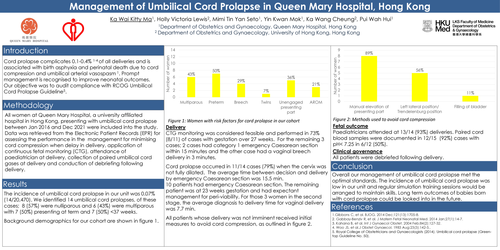
The incidence of umbilical cord prolapse in our unit was 0.07% (14/20,470). We identified 14 umbilical cord prolapses, of these cases; 8 (57%) were nulliparous and 6 (43%) were multiparous with 7 (50%) presenting at term and 7 (50%) <37 weeks.
Background demographics for our cohort are shown in figure 1.
CTG monitoring was considered feasible and performed in 73% (8/11) of cases with gestation over 27 weeks. For the remaining 3 cases; 2 cases had category 1 emergency Caesarean section within 15 minutes and the other case had a vaginal breech delivery in 3 minutes.
Cord prolapse occurred in 11/14 cases (79%) when the cervix was not fully dilated. The average time between decision and delivery by emergency Caesarean section was 15.5 min.
10 patients had emergency Caesarean section. The remaining patient was at 23 weeks gestation and had expectant management for peri-viability. For those 3 women in the second stage, the average diagnosis to delivery time for vaginal delivery was 7.7 min.
All patients whose delivery was not imminent received initial measures to avoid cord compression, as outlined in figure 2.
Paediatricians attended at 13/14 (93%) deliveries. Paired cord blood samples were documented in 12/15 (92%) cases with pH< 7.25 in 6/12 (50%).
Conclusion
Overall our management of umbilical cord prolapse met the optimal standards. The incidence of umbilical cord prolapse was low in our unit and regular simulation training sessions would be arranged to maintain skills. Long term outcomes of babies born with cord prolapse could be looked into in the future.
All patients were debriefed following delivery.