1,830 posters, 67 videos, 75 audios, 29 topics, 22 sessions, 4,727 authors, 1,697 institutions
ePostersLive by SciGen Technologies S.A. All rights reserved.
RCOG World Congress 2023
June 12 - 14, 2023 | London, UK

EP.0529
Success rate of induction of labour in twin compared to singleton pregnancies
Poster Presenter
Authors
Chun Kit Wong, Catherine Man Wai Hung, Wing Cheong Leung, Wai Lam Lau
Affiliations
Part of Topic
Labour Ward Management
The success rate of induction of labour in twin compared to singleton pregnancies
CK Wong , Catherine MW Hung, WC Leung, WL Lau
Department of Obstetrics & Gynaecology , Kwong Wah Hospital, Hong Kong
--------------------------------------------------------------------------------------------------------
Introduction
•Compared to singleton pregnancies, twin pregnancies are more likely to deliver earlier by induction of labour to reduce risk of maternal and fetal complications.
•International studies showed conflicting results in the success rate of induction of labour in twin pregnancies as compared to singleton pregnancies.
Objective
•To evaluate the success rate of induction of labour in twin pregnancies undergoing induction of labour , in comparison to singleton
Materials and method
• Study design
•A retrospective matched cohort study conducted in a regional hospital in Hong Kong over 8 years.
•Twin pregnancies more than 24 weeks of gestation and with intact membranes undergoing induction of labour were identified using an electronic record system between January 2012 and December 2020 at a Hong Kong regional obstetrics unit.
•The exclusion criteria include premature rupture of membranes, latent phase of labour , active phase of labour , threatened preterm labour which goes into spontaneous labour and intrauterine fetal death.
•For the purpose of comparison, singleton pregnancies that underwent induction of labour during the study period are matched in one to one ratio for the parity (nulliparous or multiparous), maternal age (advanced maternal age >= 35 year old or not) and the
indication of induction of labour . The control patient delivered closest to the delivery date of the study patient is selected. The identical inclusion and exclusion criteria were applied to two groups of patients.
Statistical analysis
• McNemar’s test is used in this matched case control analysis.
• P value of <0.05 taken as statistically significant
Results
• A total of 160 patients with twin pregnancies were included and matched with patients with singleton
pregnancies in one to one ratio. There were 90 nulliparous and 70 multiparous patients.
• In patients with twin pregnancies undergoing induction of
labour , the number of successful vaginal deliveries and caesarean sections were 118 (73.8%) and 41 (25.6%), respectively. One twin (0.6%) was delivered by caesarean section following vaginal delivery of the first twin. Among the matched singleton pregnancies
undergoing induction of labour , 134 (83.8%) patients had successful vaginal deliveries and 26 (16.3%) patients underwent caesarean section.
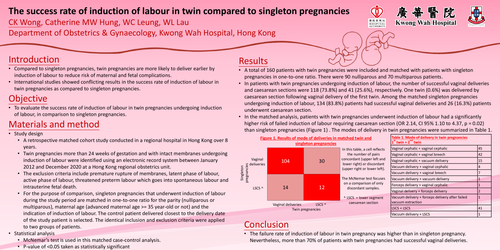
• In the matched analysis, patients with twin pregnancies underwent induction of labour had a significantly higher risk of failed induction of labour requiring caesarean section (OR 2.14, CI 95% 1.10 to 4.37, p = 0.02) than singleton pregnancies (Figure 1) . The modes of delivery in twin pregnancies were summarized in Table 1.
Conclusion
• The failure rate of induction of labour in twin pregnancy was higher than in singleton pregnancy. Nevertheless, more than 70% of patients with twin pregnancies had successful vaginal deliveries.