Loading...

1,830 posters, 67 videos, 75 audios, 29 topics, 22 sessions, 4,727 authors, 1,697 institutions

ePostersLive by SciGen Technologies S.A. All rights reserved.

RCOG World Congress 2023

June 12 - 14, 2023 | London, UK

RCOG World Congress 2023 banner

EP.0519

Preterm birth prevention: a clinical and educational quality improvement project
Part of Topic

High Risk Pregnancy

Preterm birth prevention: a clinical and educational quality improvement project

Isabelle Kelly (Medical Student), Sofia Gron (Medical Student), Irene Gafson (Obstetric Consultant) and Anna Lawin-O’Brien (Fetal Medicine Consultant)

Objective:
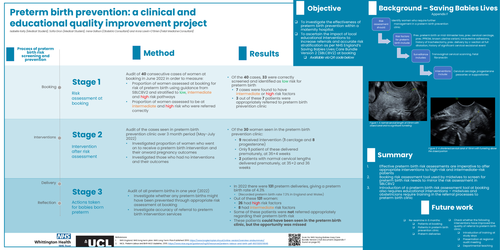
To investigate the effectiveness of preterm birth prevention within a maternity hospital.
To ascertain the impact of local educational interventions to increase referrals and accurate risk stratification as per NHS England’s Saving Babies Lives Care Bundle Version 2 (SBLCBV2) at booking
Available via QR code below
 

Background – Saving Babies Lives

Risk assessment shoudld: 

Identify women who require further management in a preterm birth prevention clinic

Risk factors for preterm birth include:

Prev. preterm birth or mid-trimester loss, prev. cervical cerclage, prev. PPROM, known uterine variant, intrauterine adhesions, history of trachelectomy, prev. delivery by c-section at full dilatation, history of significant cervical excisional event

Surveillance includes:

Transvaginal cervical scanning, Fetal fibronectin

Interventions include:

Cervical cerclage, progesterone pessaries or suppositories


Stage 1 Method

Audit of 40 consecutive cases of women at booking in June 2022 in order to measure:

•Proportion of women assessed at booking for risk of preterm birth using guidance from SBLCBV2 and stratified to low, intermediate and high risk pathways
•Proportion of women assessed to be at intermediate and high risk who were referred correctly

Stage 1 Results

•Of the 40 cases, 33 were correctly screened and identified as low risk for preterm birth
•7 cases were found to have intermediate or high risk factors
•3 out of these 7 patients were appropriately referred to preterm birth prevention clinic
 

Stage 2 Method

Audit of the cases seen in preterm birth prevention clinic over 3 month period (May-July 2022)

•Investigated proportion of women who went on to receive a preterm birth intervention and their onward pregnancy outcomes
•Investigated those who had no interventions and their outcomes

Stage 2 Results

•Of the 30 women seen in the preterm birth prevention clinic:
•9 received intervention (1 cerclage and 8 progesterone) 
•Only 1 patient of these delivered prematurely, at 36+4 weeks
•2 patients with normal cervical lengths delivered prematurely, at 35+2 and 36 weeks
 

Stage 3 Method

Audit of all preterm births in one year (2022)

•Investigate whether any preterm births might have been prevented through appropriate risk assessment at booking
•Investigate accuracy of referral to preterm birth intervention services

Stage 3 Results

•In 2022 there were 131 preterm deliveries, giving a preterm birth rate of 4.3%
•(Recorded preterm birth rate 7.3% in England and Wales)
•Out of these 131 women:
•26 had high risk factors
•8 had intermediate risk factors
•Some of these patients were not referred appropriately regarding their preterm birth risk

These patients could have been seen in the preterm birth prevention clinic but the opportunity was missed


Summary

1.Effective preterm birth risk assessments are imperative to offer appropriate interventions to high-risk and intermediate-risk patients
2.Booking risk assessment tool used by midwives to screen for preterm birth risk needs to mirror the risk assessment in SBLCBV2
3.Introduction of a preterm birth risk assessment tool at booking also requires educational interventions – midwives and obstetricians require training in the referral processes to preterm birth clinic
 
 
Future work:
Re-examine in 6 months:
Patients at booking
Patients in preterm birth prevention clinic
Preterm deliveries
 
Check whether the following interventions have improved the quality of referral to preterm birth clinic:
Introduction of training at study days
Presentation at regional audit meeting
Departmental teaching
 
References
1.NHS England. NHS long term plan. NHS Long Term Plan.Published 2019. https://www.longtermplan.nhs.uk/online-version/overview-andsummary/
RCOG World Congress 2023 » banner
Copyright © 2015-2026, ePostersLive® SciGen is a registered trademark of SciGen Technologies S.A. Patent pending.

This website and third-party tools we use rely on cookies for the best user experience. By selecting "I agree", you agree to cookie usage as described in our Privacy Policy.