1,830 posters, 67 videos, 75 audios, 29 topics, 22 sessions, 4,727 authors, 1,697 institutions
ePostersLive by SciGen Technologies S.A. All rights reserved.
RCOG World Congress 2023
June 12 - 14, 2023 | London, UK

EP.0508
Haematometra and bilateral haematosalpinges following endometrial ablation – A Case Report
Poster Presenter
Authors
Affiliations
Part of Topic
Benign Gynaecology
Haematometra and bilateral haematosalpinges following endometrial ablation
Introduction
Post-operative haematometra occurs in 1-2% of women undergoing endometrial ablation. Menstrual blood is retained due to scarring of the uterine cavity, leading to cyclic cramping pain years after the procedure.
Objectives
Case History
A 34F with parity of two presented with menorrhagia after failure of hormonal therapies. Endometrial ablation (EA) was performed in August 2019. She was symptom-free at six-months follow-up.
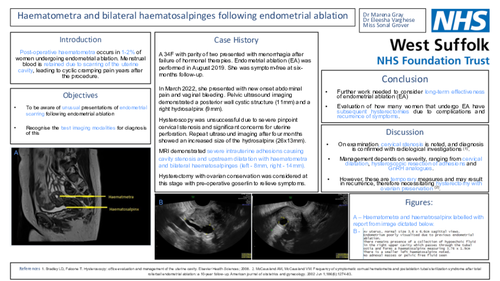
In March 2022, she presented with new onset abdominal pain and vaginal bleeding. Pelvic ultrasound imaging demonstrated a posterior wall cystic structure (11mm) and a right hydrosalpinx (9mm).
Hysteroscopy was unsuccessful due to severe pinpoint cervical stenosis and significant concerns for uterine perforation. Repeat ultrasound imaging after four months showed an increased size of the hydrosalpinx (26x13mm).
MRI demonstrated severe intrauterine adhesions causing cavity stenosis and upstream dilatation with haematometraand bilateral haematosalpinges (left - 8mm, right - 14mm).
Hysterectomy with ovarian conservation was considered at this stage with pre-operative goserlin to relieve symptoms.
Discussion
Conclusion