1,830 posters, 67 videos, 75 audios, 29 topics, 22 sessions, 4,727 authors, 1,697 institutions
ePostersLive by SciGen Technologies S.A. All rights reserved.
RCOG World Congress 2023
June 12 - 14, 2023 | London, UK

EP.0504
Reproductive outcomes following high-energy pelvic fractures, a systematic review and meta-analysis
Poster Presenter
Authors
Affiliations
University College London, University of Aberdeen, NHS Grampian
Part of Topic
Reproductive Medicine/Assisted Reproduction
Audio
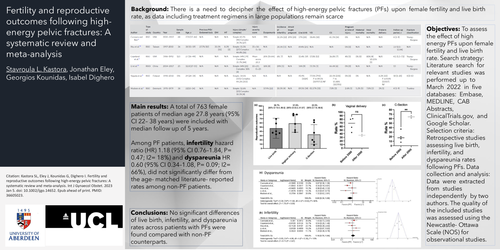
Fertility and reproductive outcomes following high-energy pelvic fractures: A systematic review and meta-analysis
Background: There is a need to decipher the effect of high-energy pelvic fractures (PFs) upon female fertility and live birth rate, as data including treatment regimens in large populations remain scarce.
Objectives: To assess the effect of high energy PFs upon female fertility and live birth rate. Search strategy: Literature search for relevant studies was performed up to March 2022 in five databases: Embase, MEDLINE, CAB Abstracts, ClinicalTrials.gov, and Google Scholar. Selection criteria: Retrospective studies assessing live birth, infertility, and dyspareunia rates following PFs. Data collection and analysis: Data were extracted from studies independently by two authors. The quality of the included studies was assessed using the Newcastle- Ottawa Scale (NOS) for observational studies.
Main results: A total of 763 female patients of median age 27.8 years (95% CI 22– 38 years) were included with median follow up of 5 years. Among PF patients, infertility hazard ratio (HR) 1.18 (95% CI 0.76–1.84, P= 0.47; I2= 18%) and dyspareunia HR 0.60 (95% CI 0.34–1.08, P= 0.09; I2= 66%), did not significantly differ from the age- matched literature- reported rates among non-PF patients.
Conclusions: No significant differences of live birth, infertility, and dyspareunia rates across patients with PFs were found compared with non-PF counterparts.