1,830 posters, 67 videos, 75 audios, 29 topics, 22 sessions, 4,727 authors, 1,697 institutions
ePostersLive by SciGen Technologies S.A. All rights reserved.
RCOG World Congress 2023
June 12 - 14, 2023 | London, UK

EP.0501
Impact of obesity and bariatric surgery on anti-mullerian hormone levels in women
Poster Presenter
Part of Topic
Obesity
Objective
Bariatric surgery increases spontaneous fertility in young women, but its impact on ovarian reserve is uncertain.
We evaluated the impact of bariatric surgery on anti-mullerian hormone (AMH) levels in women of reproductive age.
Design
Prospective cohort study of women aged 18-45 years undergoing bariatric surgery and a control group of women living with obesity not undergoing surgery.
AMH levels were measured in both cases and controls at baseline and 12-24 months after surgery (cases) and at a comparable timepoint in controls.
Methods
Women were recruited from bariatric services. Cases were awaiting surgery; controls were receiving dietary advice prior to consideration for surgery. Both groups met the NHS criteria for bariatric surgery. Eighty-five cases and 18 controls were recruited and had baseline AMH levels measured, 36 cases and nine controls had follow-up AMH levels.
Baseline, follow-up levels and change in AMH were compared between cases and controls and evaluated with respect to participant age and anthropometric measurements.
AMH levels in the cases were further evaluated by diagnosis of PCOS and surgical procedure (gastric bypass or sleeve).
Intention-to-treat analysis was used throughout.
Results
Mean baseline BMI in cases and controls was 49 ± 8.5 and 52 ± 9.8 kg/m2 respectively.
AMH dropped significantly after surgery (16.6 ± 15.6 pmol/L to 16.0 ± 19 pmol/L, P=0.004).
No change was seen in controls.
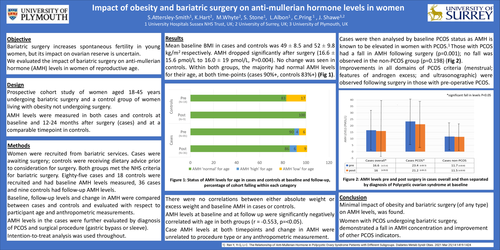
Within both groups, the majority had normal AMH levels for their age, at both time-points (cases 90%+, controls 83%+) (Fig 1).
There were no correlations between either absolute weight or excess weight and baseline AMH in cases or controls.
AMH levels at baseline and at follow up were significantly negatively correlated with age in both groups (r = -0.553, p=<0.05).
Case AMH levels at both timepoints and change in AMH were unrelated to procedure type or any anthropometric measurement.
Cases were then analysed by baseline PCOS status as AMH is known to be elevated in women with PCOS.1 Those with PCOS had a fall in AMH following surgery (p=0.001); no fall was observed in the non-PCOS group (p=0.198) (Fig 2).
Improvements in all domains of PCOS criteria (menstrual; features of androgen excess; and ultrasonographic) were observed following surgery in those with pre-operative PCOS.
Conclusion
Minimal impact of obesity and bariatric surgery (of any type) on AMH levels, was found.
Women with PCOS undergoing bariatric surgery, demonstrated a fall in AMH concentration and improvement of other PCOS indicators.