1,830 posters, 67 videos, 75 audios, 29 topics, 22 sessions, 4,727 authors, 1,697 institutions
ePostersLive by SciGen Technologies S.A. All rights reserved.
RCOG World Congress 2023
June 12 - 14, 2023 | London, UK

EP.0494
A rare case of Pemphigoid gestationis in pregnant diabetic female
Poster Presenter
Part of Topic
Maternal Medicine
30 years old female in her second pregnancy ,diet controlled Gestational Diabetes Mellitus presented at 24+3/40 with one week history of an intensely itchy rash. This was first noticed at 23 weeks of gestation. It was initially on her wrist and leg before becoming generalized to involve her hands, legs, trunk, back and abdomen. It did not start in her stretch marks or around her umbilicus. The rash started 10 days after commencing Metformin 500 mg OD.
There were no lesions in her mouth or genital areas,no blisters,no rapid weight gain in this pregnancy and there was no history of a similar rash during her previous pregnancy. There was neither a history of pre-existing skin conditions, nor any hay fever or asthma.
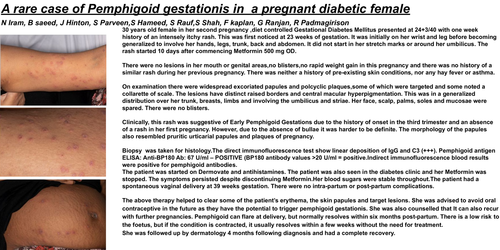
On examination there were widespread excoriated papules and polcyclic plaques,some of which were targeted and some noted a collarette of scale. The lesions have distinct raised borders and central macular hyperpigmentation. This was in a generalized distribution over her trunk, breasts, limbs and involving the umbilicus and striae. Her face, scalp, palms, soles and mucosae were spared. There were no blisters.
Clinically, this rash was suggestive of Early Pemphigoid Gestations due to the history of onset in the third trimester and an absence of a rash in her first pregnancy. However, due to the absence of bullae it was harder to be definite. The morphology of the papules also resembled pruritic urticarial papules and plaques of pregnancy.
Biopsy was taken for histology.The direct immunofluorescence test show linear deposition of IgG and C3 (+++). Pemphigoid antigen ELISA: Anti-BP180 Ab: 67 U/ml – POSITIVE (BP180 antibody values >20 U/ml = positive.Indirect immunofluorescence blood results were positive for pemphigoid antibodies.
The patient was started on Dermovate and antihistamines. The patient was also seen in the diabetes clinic and her Metformin was stopped. The symptoms persisted despite discontinuing Metformin.Her blood sugars were stable throughout.The patient had a spontaneous vaginal delivery at 39 weeks gestation. There were no intra-partum or post-partum complications.
The above therapy helped to clear some of the patient’s erythema, the skin papules and target lesions. She was advised to avoid oral contraceptive in the future as they have the potential to trigger pemphigoid gestationis. She was also counselled that It can also recur with further pregnancies. Pemphigoid can flare at delivery, but normally resolves within six months post-partum. There is a low risk to the foetus, but if the condition is contracted, it usually resolves within a few weeks without the need for treatment.
She was followed up by dermatology 4 months following diagnosis and had a complete recovery.